
This comparison is part of our Dry Solid Lubricant Powders resource center. The individual product pages contain specifications, SDS/TDS documents, particle sizes and pack options for hBN, MoS2, WS2 and graphite.
The selection of a solid lubricant depends on the temperature, electrical requirements, load and operating atmosphere. The performance of hexagonal boron nitride (hBN), molybdenum disulfide (MoS₂), tungsten disulfide (WS₂) and graphite are all different, so the best one depends on the application. This guide compares the four and shows which is right for which job.
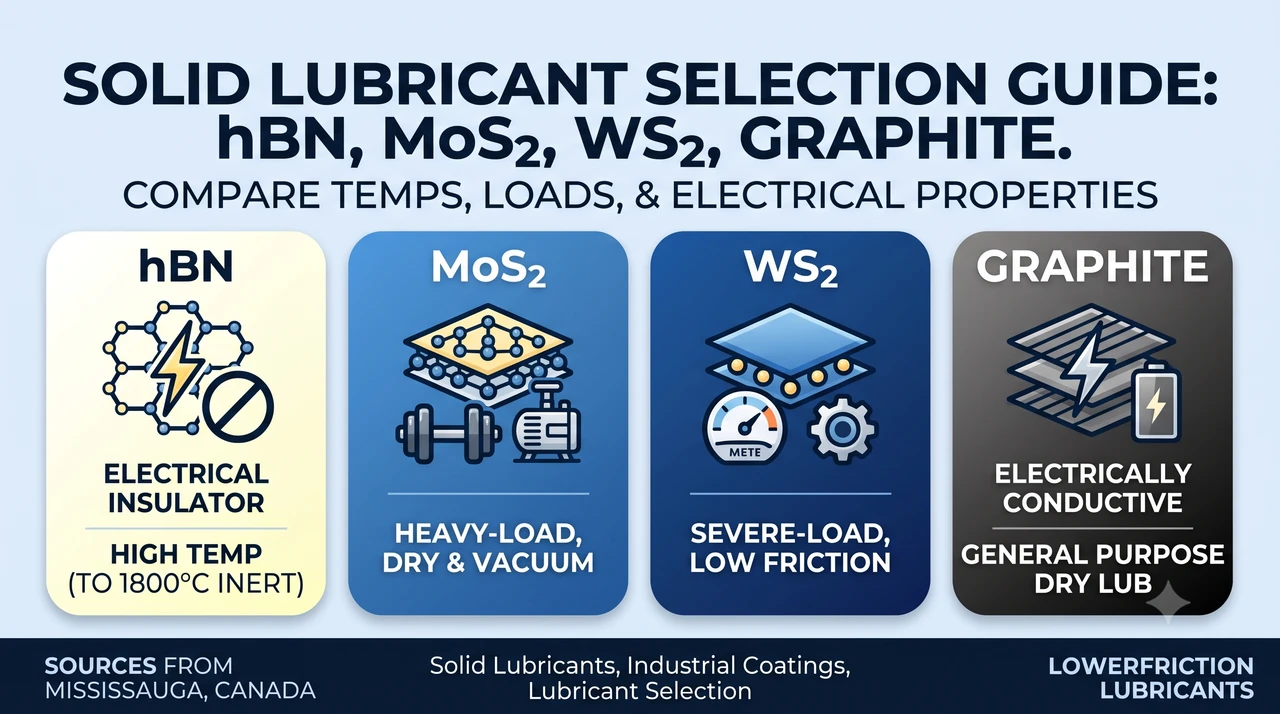
In brief: if you need electrical insulation and heat resistance, then hBN is the right choice, which works up to 1000°C in air, 1400°C in vacuum and 1800°C in an inert atmosphere. Use MoS₂ for dry lubrication of heavy loads. Choose WS2 for heavy-duty, low-friction operation. Use graphite for typical dry lubrication where electrical conductivity is not an issue.
Solid lubricant selector: start with what you need
Find the requirements for your application. Each card lists the recommended solid lubricant and the reason it is suitable.
▸ Need electrical insulation and heat resistance?
Recommended: hBN (hexagonal boron nitride)
Temperature limit: 1000°C in air, 1400°C in vacuum, 1800°C in inert atmosphere.
Why it fits: hBN is an electrical insulator with high load capability and non-wetting behavior, thus the choice for high-temperature lubrication where conductivity must be avoided.
▸ Need heavy-load dry lubrication?
Recommended: MoS₂ (molybdenum disulfide)
Environment: Dry and vacuum conditions.
Why it fits: MoS₂ has a good load-carrying capacity and performs well in dry and vacuum conditions. It is conductive so it is not selected where insulation is required.
▸ Need severe-load, low-friction performance?
Recommended: WS₂ (tungsten disulfide)
Environment: Hard dry and vacuum environments.
Why it fits: WS₂ is a very high-load, low-friction material with low-friction performance in severe conditions. It is not an electrical-insulation choice such as MoS2.
▸ Need conventional dry lubrication where conductivity is acceptable?
Recommended: Graphite
Environment: Depends on atmosphere and humidity.
Why it fits: Graphite is a well-known general solid lubricant and is electrically conductive. Its lubrication performance is strongly dependent on the atmosphere and moisture, so please confirm the operating environment first.
hBN vs MoS₂ vs WS₂ vs graphite at a glance
The distinguishing characteristic of each material and what it is most suited for.
| hBN | Electrical insulator Insulating, non-wetting, high-temperature lubrication. |
| MoS₂ | Strong high-load Heavy-load dry lubrication. |
| WS₂ | Very high-load Low friction under severe conditions. |
| Graphite | Electrically conductive General-purpose dry lubrication. |
Solid lubricant comparison table: hBN, MoS₂, WS₂ and graphite
Electrical behavior, temperature and environment, load direction and main advantage of each material, side by side.
| Material | Electrical behaviour | Temperature/environment | Load direction | Key advantage |
|---|---|---|---|---|
| hBN | Electrical insulator | Up to 1000°C air, 1400°C vacuum, 1800°C inert atmosphere | High-load capability | Non-wetting; high-temperature lubrication |
| MoS₂ | Conductive / not selected for insulation | Performs well in dry and vacuum conditions | Strong high-load performance | Heavy-load dry lubrication |
| WS₂ | Not an electrical-insulation choice | Suitable for demanding dry/vacuum environments | Very high-load direction | Low-friction performance under severe conditions |
| Graphite | Electrically conductive | Lubrication performance depends strongly on atmosphere and moisture | Application-dependent | Established general-purpose solid lubricant |
Typical manufacturer values of temperature limits and load figures are dependent on grade, film condition, test method and operating condition. Check the current TDS for the exact range.
Why hBN stands apart from MoS₂, WS₂ and graphite
An important benefit of hBN is that it unites lubricity, electrical insulation and non-wetting properties, particularly toward glass, salts and most metals. MoS2, WS2 and graphite are all conductive to some degree, so hBN is the only one of the four to choose when the lubricated surface must also be electrically isolated. This advantage is extended into hot processes such as glass handling, metal forming and mold release, where a temperature ceiling of 1000°C in air, rising to 1400°C in vacuum and 1800°C in an inert atmosphere.
hBN vs MoS₂ vs WS₂ vs graphite: frequently asked questions
Which solid lubricant is best overall?
There is no one best solid lubricant. hBN is good for electrical insulation and heat resistance. MoS2 is good for heavy-load dry lubrication. WS2 is good for severe-load low-friction performance. Graphite is the standard for conventional dry lubrication when conductivity can be tolerated.
Which solid lubricant is an electrical insulator?
Among the four, hBN is the electrical insulator. Graphite conducts electricity, so when you need insulation, you don’t use MoS₂ or WS₂.
Which solid lubricant handles the highest temperature?
hBN. It lubricates up to ~1000C in air, 1400C in vacuum and 1800C in an inert atmosphere, well beyond the working range of MoS₂ and WS₂.
MoS₂ or WS₂ for high-load applications?
Both are high-load materials. MoS2 shows good performance under high load for dry lubrication of heavy loads; WS2 is for very high-load applications with low friction under severe conditions. With extreme loads and the need to minimize friction WS₂ is the common choice.
When should I choose graphite over hBN, MoS₂ or WS₂?
Graphite for traditional dry lubrication when electrical conductivity is permissible. Its performance is very atmosphere- and moisture-dependent and therefore less suitable for vacuum or very dry conditions where MoS2 or WS2 are better performers.
What does non-wetting mean for hBN?
If the surface of hBN is non-wetting, molten materials will not wet it. hBN is therefore used around glass, salts, and most metals where it acts as a lubricant and release agent without contaminating or sticking to the material being processed.
Compare hBN, MoS₂, WS₂ and graphite for your application
Download brochures and SDS, compare grades, particle sizes and pack options or contact a Lowerfriction specialist with your temperature, load, electrical and atmosphere requirements.
View Dry Solid Lubricant PowdersSources: hBN, MoS₂, WS₂ and graphite product brochures (M K Impex Corp. / Lowerfriction Lubricants). Typical values for temperature and load figures are given by the manufacturer and these are dependent on grade, film condition, test method and operating conditions. Exporting From Mississauga, Canada, to 50+ Countries Since 2004.
This article offers general technical information, not application-specific engineering or safety advice. Results are dependent on product, material, method, equipment and operating conditions. Please refer to the SDS, TDS and product instructions to confirm suitability prior to use in a wider application. Test a small sample first. Read the full Technical Information and Use Disclaimer.