
LOWER FRICTION | TECHNICAL GUIDE
Lubricant is not just a slippery coating between moving parts. Its formulation may also have to resist oxidation, reduce wear, control deposits, protect surfaces from corrosion and perform under varying loads. And additives help to achieve those functions. The more useful question for formulators is not, which additive has the lowest friction coefficient? Which additive does the job in the complete lubricant system?
Lubricant additives by the numbers
| Evidence | Reported result | What the figure actually means |
|---|---|---|
| Typical formulation example | 90–95% base oil; 5–10% dissolved additives | The Institution of Mechanical Engineers describes this as a typical commercial lubricant, not a universal formula or recommended solids dosage. [1] |
| MoS₂ in palm-kernel-oil-based lubricant | Up to 24.9% lower friction coefficient | Maximum result reported in a 2024 four-ball comparison of formulated nano-additives against its base lubricant. [2] |
| MoS₂ in the same study | Up to 12.3% smaller wear-scar diameter | A wear-scar measurement under that study's test conditions; it is not a claim about equipment life. [2] |
| hBN in calcium grease | Up to 18.2% lower friction and 70.2% less measured wear | Best reported results in a 2025 investigation of a particular 3 wt% hBN formulation with approximately 130 nm average particles. [3] |
| Recent nanolubricant research | 129 studies reviewed | A 2026 systematic review screened studies published during 2023–2025 and identified variability in methods and gaps in long-term evidence. [4] |
What do lubricant additives do?
Base oils provide fluidity and a separating film, but they do not, by themselves, solve all operating problems. An industrial gearbox may require protection against loads, a hydraulic fluid may require oxidation control and antifoaming performance, and a bearing grease may require protection against wear and corrosion. A formulated product usually will contain a blend of several additive functions.
The following classification draws on the Institution of Mechanical Engineers' Tribological Design Guide and the ASM Handbook's treatment of additive functions. [1, 5]
| Additive type | Main function | What a formulator evaluates |
|---|---|---|
| Friction modifiers | Lower friction in relevant contact conditions | Friction response at intended load, speed and temperature |
| Antiwear (AW) additives | Reduce surface damage during boundary or mixed lubrication | Wear scars, surface condition and compatibility |
| Extreme-pressure (EP) additives | Help resist scuffing or seizure under severe loading | Load-carrying test results and material compatibility |
| Antioxidants | Slow oxidative degradation of the lubricant | Oxidation stability over the intended service period |
| Rust and corrosion inhibitors | Protect metal surfaces against chemical attack | Metal-specific corrosion and water-contamination tests |
| Detergents | Limit deposit formation and help keep hot surfaces clean | Deposit-control performance in the target system |
| Dispersants | Keep certain contaminants or deposits suspended | Contaminant handling and sludge control |
| Viscosity-index improvers | Moderate the change of viscosity with temperature | Low- and high-temperature viscosity behavior |
| Pour-point depressants | Improve low-temperature flow in suitable oils | Cold-flow response of the base-oil blend |
| Foam inhibitors | Reduce persistent foam | Foaming and air-release characteristics |
How do lubricant additives work?
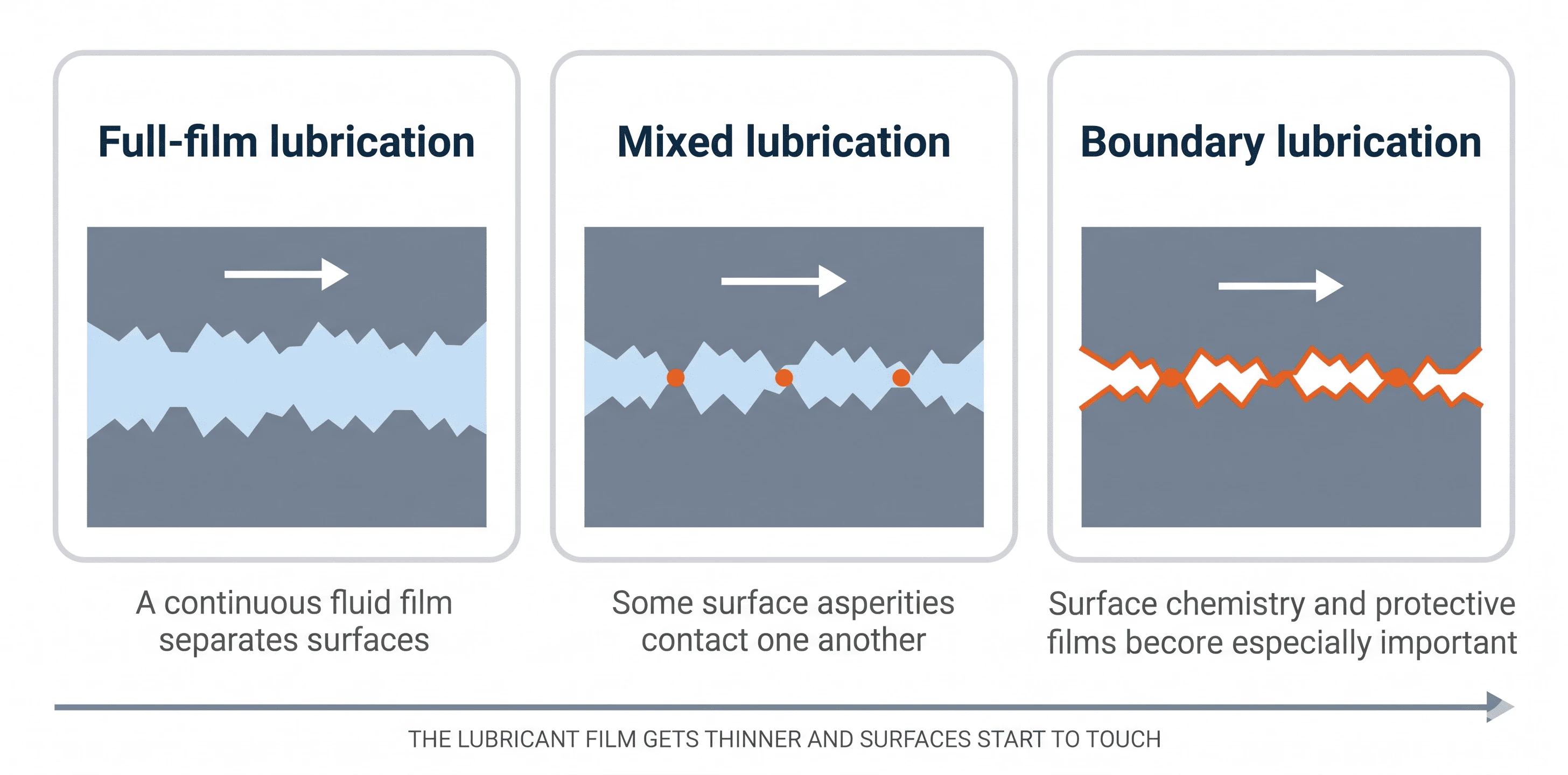
Lubrication conditions change as load, speed, surface roughness and temperature change. Under full-film lubrication, a continuous fluid film separates surfaces. Under mixed lubrication, some surface asperities contact one another. Under boundary lubrication, surface chemistry and protective films become especially important. [1]
Additives act by a variety of mechanisms:
- Chemical action: Some antiwear or EP compounds react and form protective films at the interface.
- Surface adsorption: Some friction modifiers deposit thin films on the contacting surfaces.
- Bulk-fluid control: Antioxidants, viscosity modifiers and foam inhibitors are used primarily to alter the way the lubricant behaves as a fluid.
- Solid-particle action: Individual particles can come into contact, shear, form surface films or affect wear behavior. The effect is dependent on the properties of the particles and the surrounding formulation.
A solid additive therefore works in a system, not in isolation. Its performance as a dry friction material is not the same as when it is dispersed in an oil or grease.
Chemical additives versus solid lubricant additives
| Question | Dissolved or chemically active additives | Dispersed solid additives |
|---|---|---|
| Typical form | Soluble components or chemical packages | Fine particles in a compatible carrier |
| Possible mechanism | Adsorption, reaction films, oxidation control or other chemical effects | Low-shear action, physical surface interaction and, in some systems, tribofilm formation |
| Important formulation variables | Concentration, additive interactions, oil chemistry, temperature | Particle-size distribution, agglomeration, settling, filtration and carrier compatibility |
| What success requires | Testing of the complete lubricant | Testing of the complete dispersion and lubricant |
| Are they interchangeable? | No | No; a solid powder does not replace a complete additive package |
Four solid raw materials used in lubricant development
Lower Friction provides molybdenum disulfide (MoS₂), tungsten disulfide (WS₂), hexagonal boron nitride (hBN) and micronized PTFE as industrial powders. The supplier brochures include applications in oils, greases, coatings and/or other formulations. These are raw materials for formulation and evaluation, not finished, ready-to-pour additive packages.
Explore Lower Friction's dry and solid lubricant powder category →
Molybdenum disulfide (MoS₂): a layered solid for lubrication and wear research
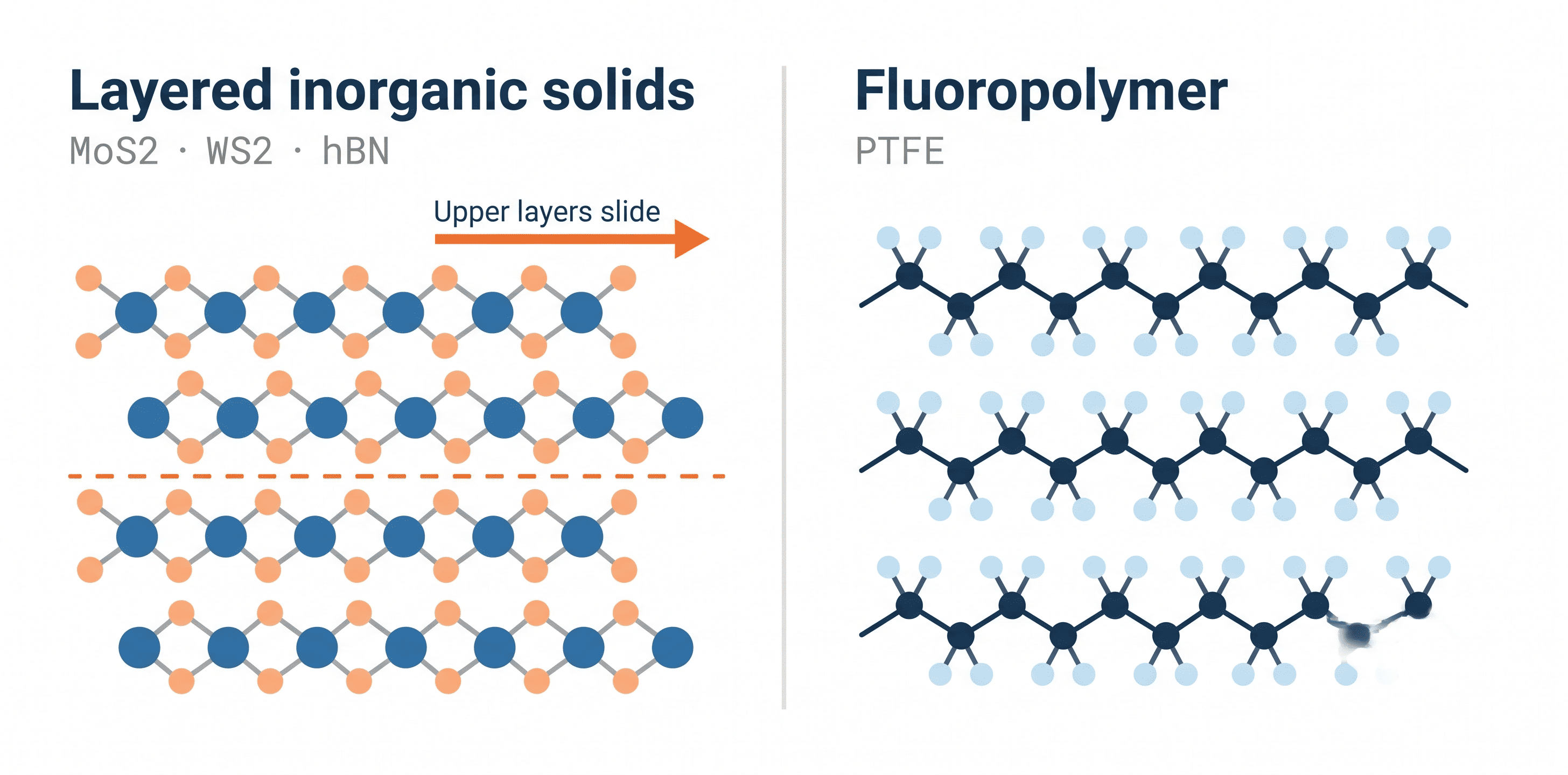
MoS₂ is a layered material used in dry lubrication and as a candidate solid component in greases and oils. Lower Friction's MoS₂ brochure specifically lists grease, oil, polymer, paint and coating applications. The lamellar structure explains why it is studied in situations where surfaces slide against each other. The appropriate grade is still dependent on the carrier, operating conditions and intended contact.
The supplier brochure lists 90 nm, 1.5 µm, 4.5 µm and 12.5 µm sizes; larger sizes may be available by custom order. The supplied SDS identifies the material as MoS₂, CAS 1317-33-5, with a density of approximately 5.06 g/cm³. Particle size and packaging should be confirmed for the particular grade. [6]
See molybdenum disulfide powder grades →
Tungsten disulfide (WS₂): a candidate for low-friction sliding applications
WS₂ is another layered material. Lower Friction's WS₂ brochure describes addition to oils, lubricants and other carriers, alongside separate dry-coating uses. The document reports a 0.03 dynamic coefficient of friction and 300,000 psi load-bearing capability for a coated film. Those figures describe brochure-reported material or coated-film conditions, not the measured behavior of a formulated oil. [7]
The brochure describes nano and 0.4–1.0 µm submicron grades; the live category lists a 0.6 µm product. The supplied SDS lists CAS 12138-09-9 and density around 7.5 g/cm³. [7]
See tungsten disulfide powder grades →
Hexagonal boron nitride (hBN): a candidate for specialized and high-temperature formulations
Often called white graphite because of its layered hexagonal structure, hBN is described in Lower Friction's brochure as a lubricant additive for oils, greases, water-based systems and solvents. The same document identifies high-temperature lubrication as an application. hBN is also an electrical insulator and a thermal conductor, properties that can be relevant when evaluating specialized materials and coatings. [8]
Lower Friction currently lists 70 nm, 0.5 µm, 1.5 µm, 5 µm and 30 µm hBN grades, with a material density of approximately 2.3 g/cm³. In the independent 2025 grease study discussed below, the best-performing hBN formulation had an approximately 130 nm average particle size, not an identified Lower Friction grade. [3, 8]
See hexagonal boron nitride powder grades →
Micronized PTFE: a low-friction polymer additive candidate
Unlike the three layered inorganic powders, PTFE is a fluoropolymer. Lower Friction's MK-PTFE-270 brochure describes its use in lubricants, greases, oils, coatings and polymers. It is relevant when a formulator needs to evaluate slip, surface characteristics or wear modification in a compatible system. [9]
The MK-PTFE-270 brochure reports D50 particle size below 3 µm, specific gravity 2.16 g/cm³, specific surface area 3 m²/g, moisture content below 0.1 wt% and packs of 1, 5 and 25 kg. Its brochure lists a melting point of 325°C, while the supplied SDS lists 321°C; those document values should not be presented as one exact certified grade specification without confirmation. [9]
See micronized PTFE lubricant additive powder →
Technical comparison: which data actually matter?
The values below are taken from Lower Friction's supplied brochures, safety data sheets and current product listings. They describe documented material/grade information, not current stock commitments or comparative performance in finished lubricants.
| Material | CAS number | Density (approx.) | Documented particle sizes / grade data |
|---|---|---|---|
| MoS₂ | 1317-33-5 | 5.06 g/cm³ | 90 nm; 1.5, 4.5, 12.5 µm; custom larger sizes mentioned |
| WS₂ | 12138-09-9 | 7.5 g/cm³ | Nano and 0.4–1.0 µm submicron range; 0.6 µm listed online |
| hBN | 10043-11-5 | 2.3 g/cm³ | 70 nm; 0.5, 1.5, 5, 30 µm (current listing) |
| PTFE (MK-PTFE-270) | 9002-84-0 | 2.16 g/cm³ | D50 < 3 µm; 3 m²/g specific surface area |
At equal weight, hBN and PTFE take up roughly 3.3–3.5 times the volume of WS₂.
What does peer-reviewed research show about solid lubricant additives?
Research supports the potential of selected layered and other nanoparticles, but the results must be read with their experimental context.
| Research | Formulation and test context | Reported result | Practical lesson |
|---|---|---|---|
| Azman et al., 2024 [2] | Graphite, hBN and MoS₂ nano-additives in palm-kernel-oil-based lubricants; four-ball tribotester | MoS₂ formulation: up to 24.9% reduction in friction coefficient and 12.3% reduction in wear-scar diameter vs the base lubricant | Evaluate a specific additive in a specific carrier; do not transfer the percentages to another oil or grade. |
| Senyk et al., 2025 [3] | hBN particles in lithium and calcium greases; best formulation at 3 wt% hBN, average particle size 130 nm, in reciprocating steel-on-steel tests | In calcium grease, up to 18.2% less friction and 70.2% less measured wear; in lithium grease, up to 9.7% and 69.2%, respectively | Grease chemistry and particle characteristics can change the outcome considerably. |
| Zaharin et al., 2026 [4] | Systematic review of peer-reviewed research published in 2023–2025 | 129 studies selected for detailed analysis | Research activity is substantial, but methods vary and long-term field durability remains a gap. |
Two findings are especially useful for formulators. First, the 2025 hBN study found that 10% loading could perform worse than intermediate concentrations in the examined grease systems; more powder was not automatically better. Second, the researchers attributed differences between lithium and calcium grease results partly to differences in the base grease structure. These are strong reasons to test the actual carrier rather than treat a published percentage as a product specification. [3]
No independent study above identifies Lower Friction's listed grades as its tested samples. A supplier brochure or SDS is also not a substitute for a tribological test report.
How to select a solid lubricant additive for a formulation
Start with the failure mode or property you need to change, then shortlist raw materials and test the resulting lubricant.
| Formulation goal | Materials worth evaluating | Critical question before selection |
|---|---|---|
| Reduce boundary friction in an industrial oil | MoS₂ or WS₂; potentially hBN depending on the system | Does the dispersed material remain stable and improve friction under target test conditions? |
| Develop an industrial grease with better wear performance | MoS₂, WS₂, hBN or PTFE, depending on the base grease | Is the powder compatible with the thickener and does it improve measured wear? |
| Develop a high-temperature industrial lubrication system | hBN; MoS₂ or WS₂ subject to atmosphere and grade suitability | Does the complete formulation tolerate the required operating temperature? |
| Add slip or wear-modifying properties to a polymer/coating formulation | Micronized PTFE; other powders where appropriate | Does the additive disperse and preserve other required properties? |
| Use a fine filtration or narrow-clearance oil system | No material should be selected from particle size alone | Will agglomerates, filtration, clearances and system design permit its use? |
Six questions to avoid poor additive choices
How should lubricant additives be tested?
A practical validation program compares an unmodified baseline lubricant to controlled trial formulations. Document base oil or grease, material grade, particle size, loading, mixing method, storage time, load, speed, temperature and test duration. Then repeat the appropriate measurements.
| Test / standard | Principal measurement | When it helps |
|---|---|---|
| ASTM D4172 [10] | Wear-preventive characteristics of lubricating fluids using the four-ball method | Preliminary wear comparison for oil formulations |
| ASTM D5183 [11] | Coefficient of friction of lubricants using a four-ball machine | Friction comparison under prescribed test conditions |
| ASTM D2783 [12] | Extreme-pressure properties of lubricating fluids | Fluid load-carrying evaluation |
| ASTM D2266 [13] | Wear-preventive characteristics of lubricating grease | Grease wear assessment |
| ASTM D2596 [14] | Extreme-pressure properties of lubricating grease | Grease load-carrying assessment |
These standards are examples of appropriate testing, not evidence that Lower Friction's powders have passed them. A bench-test result also does not automatically establish field performance; application-specific qualification may be necessary.
Suggested evaluation sequence:
- 1Define a target
- 2select a powder grade
- 3create controlled baseline and trial formulations
- 4check initial dispersion
- 5test after storage
- 6measure friction/wear/EP as relevant
- 7examine surfaces and filtration behavior
- 8proceed to application testing only if the complete formulation meets requirements.
What should be recorded in a useful lab report?
| Record | Why it matters |
|---|---|
| Baseline lubricant identification | Makes comparisons meaningful |
| Powder manufacturer, grade, CAS and batch | Helps reproduce the trial |
| Particle-size information and mixing method | Identifies variables linked to dispersion |
| Concentration stated as wt% with actual batch mass | Prevents ambiguous dose reporting |
| Before/after storage observations | Reveals settling or agglomeration concerns |
| Test method, load, temperature, speed and duration | Prevents misleading comparisons across studies |
| Friction, wear and any EP results with repeat measurements | Shows measurable effect and variability |
| Compatibility, filter and system observations | Checks whether the formulation is practical to deploy |
Common mistakes when comparing lubricant additives
| Mistake | Better decision rule |
|---|---|
| ✕Treating a dry-powder friction coefficient as an oil-test result | ✓Ask for the test setup and the finished lubricant's results. |
| ✕Assuming a smaller particle is always better | ✓Compare particle distributions, dispersion and system constraints. |
| ✕Copying a study's 3 wt% hBN loading into a different formulation | ✓Treat it as a study condition, not a universal dosing recommendation. |
| ✕Calling a raw powder a complete additive package | ✓Distinguish raw materials from formulated chemical packages and ready-to-use products. |
| ✕Using an SDS as proof of performance | ✓Use the SDS for safety; request technical data and test results for performance. |
| ✕Comparing reductions from different studies as a ranking | ✓Compare formulations under matched conditions and measured endpoints. |
Safety, handling and documentation
Solid additive powders should be handled using the current grade-specific safety data sheet, suitable dust controls and appropriate personal protection. The supplied Lower Friction SDS documents identify MoS₂ as harmful if inhaled (H332) and WS₂ with skin, eye and respiratory irritation hazards (H315, H319, H335). The provided hBN and PTFE sheets also include dust-control and exposure precautions even where the stated GHS classification differs. [6–9]
The supplied SDS revisions date from 2020–2021. Buyers should request the current revision, plus the appropriate technical specification and any available batch documentation, before handling or qualifying a material. Compatibility and regulatory checks, including those relevant to PTFE, should be performed for the intended market and end use.
Frequently asked questions about lubricant additives
+What is the difference between a lubricant additive and a lubricant?
A lubricant is the finished oil, grease or other system that is used in service. An additive is an ingredient added to alter its properties. A solid powder can be an additive raw material, but it cannot be a ready-for-use lubricant.
+What are the main types of lubricant additives?
Common types are friction modifiers, antiwear agents, extreme-pressure agents, antioxidants, corrosion inhibitors, detergents, dispersants, viscosity-index improvers, pour-point depressants and antifoam agents. Different lubricant applications need different combinations.
+Can solid lubricant powders be added to oil or grease?
Selected powders may be evaluated in compatible oils and greases, as described in the Lower Friction brochures. Successful use requires the right particle grade, a stable formulation and suitable performance testing. Adding raw powder to a finished lubricant without validation is not recommended.
+Are MoS₂ and WS₂ the same kind of additive?
Both are layered sulfide materials studied or used in lubrication. They differ in composition and physical properties. There is no need to claim one method to be better than the other, because the performance depends on the grade of particle, the carrier and the operating conditions.
+Is hexagonal boron nitride a lubricant additive?
Yes. Lower Friction's hBN brochure describes use in oils and greases, and independent research has evaluated hBN in grease formulations. Research results for a particular particle size or concentration do not establish identical performance for other grades.
+Is PTFE powder the same as a finished PTFE oil additive?
No. Micronized PTFE is a raw polymer powder and can be blended into properly formulated compounds. The oil additive, when finished, contains the required carrier and other ingredients and must be tested for its intended use.
+What does a 0.03 coefficient of friction mean for WS₂?
It is a value reported in Lower Friction's WS₂ technical brochure for dry material performance. It should not be interpreted as the friction coefficient of every lubricant containing WS₂. Finished formulations require their own testing.
+Which tests help compare lubricant additives?
Four-ball wear, friction and EP methods such as ASTM D4172, D5183 and D2783 can be relevant for fluid lubricants; D2266 and D2596 address certain grease properties. Test choice must match the formulation and application.
Raw materials for lubricant formulation and research
Lower Friction supplies dry and solid lubricant powders for industrial evaluation, including MoS₂, WS₂, hBN and micronized PTFE.
For a meaningful grade discussion, prepare the intended lubricant carrier, operating temperature, contact conditions, target improvement, particle-size constraints and testing plan. Review the grade's current technical data and SDS before use. These materials are formulation ingredients, not direct substitutes for an approved finished lubricant or complete additive package.
References and technical sources
- Institution of Mechanical Engineers, Tribological Design Guide, Part 2: Lubrication (2nd edition, 2014), especially the “Lubricant Additives” section. Read the guide.
- Azman, N. F., et al. (2024), “Tribological performance and mechanism of graphite, hBN and MoS₂ as nano-additives in palm kernel oil-based lubricants: A comparative study,” Journal of Molecular Liquids, 410, 125616. DOI: 10.1016/j.molliq.2024.125616.
- Senyk, S., et al. (2025), “Role of Base Grease Type on the Lubrication Performance of Hexagonal Boron Nitride Nanoparticles and Microparticles,” Materials, 18(10), 2196. DOI: 10.3390/ma18102196.
- Zaharin, H. A., et al. (2026), “Tribological enhancement through nanotechnology: A systematic review of nano-lubricant additives using PRISMA technique,” Proceedings of the Institution of Mechanical Engineers, Part J: Journal of Engineering Tribology, published online 2 September 2026. DOI: 10.1177/13506501261483995.
- Bardasz, E. A. (2017), “Lubricant Additives and Their Functions,” ASM Handbook, Vol. 18, pp. 135–149. DOI: 10.31399/asm.hb.v18.a0006405.
- Lower Friction / M K Impex Corp., supplied Molybdenum Disulfide Powder technical brochure and Molybdenum(IV) Sulfide Powder SDS (2021 revision).
- Lower Friction / M K Impex Corp., supplied Tungsten Disulfide (WS₂) Powder technical brochure and SDS (2021 revision).
- Lower Friction / M K Impex Corp., supplied Hexagonal Boron Nitride (hBN) Powder technical brochure and SDS (2020 revision).
- Lower Friction / M K Impex Corp., supplied MK-PTFE-270 Micronized PTFE Powder brochure and SDS (2021 revision).
- ASTM International, ASTM D4172-25, Four-Ball Wear Test for Lubricating Fluids. Standard page.
- ASTM International, ASTM D5183-25, Coefficient of Friction of Lubricants (Four-Ball). Standard page.
- ASTM International, ASTM D2783-25, Extreme-Pressure Properties of Lubricating Fluids (Four-Ball). Standard page.
- ASTM International, ASTM D2266-23, Wear-Preventive Characteristics of Lubricating Grease (Four-Ball). Standard page.
- ASTM International, ASTM D2596-26, Extreme-Pressure Properties of Lubricating Grease (Four-Ball). Standard page.
This article provides general technical information, not application-specific engineering or safety advice. Results may vary by product, materials, methods, equipment, and operating conditions. Review the current SDS, TDS, and product instructions, try a small sample first, and confirm suitability before wider use. Read the full Technical Information and Use Disclaimer