
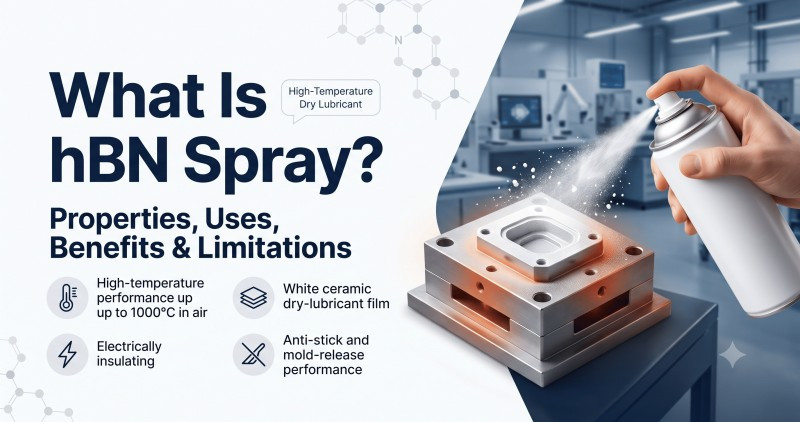
A data-first reference for engineers evaluating hexagonal boron nitride as a dry lubricant, release agent, and anti-stick coating. Reviewed against the MK-hBN-SP product SDS and brochure.
Temperature stability at a glance
Manufacturer-stated temperature capability by atmosphere — one of the main reasons engineers evaluate hBN against PTFE, silicone, graphite and conventional lubricants. Scale: 0–1800 °C.
hBN values are taken from the MK-hBN-SP product brochure. Applied-film performance depends on film thickness, substrate, load, exposure duration, surface preparation and atmosphere — validate the applied coating under actual operating conditions before production use. PTFE / silicone / oil values are typical published limits; confirm against the specific product’s TDS.
hBN powder vs paste vs coating vs aerosol spray
hBN powder, paste, bulk coating and aerosol spray are different product forms with different film thicknesses, application methods and performance data. Datasheet values from one form do not automatically apply to another.
| Form | What it is | Typical film | Best for | Trade-off | Which data applies |
|---|---|---|---|---|---|
| hBN POWDER | Raw hexagonal boron nitride particles | None (loose)burnished or compounded | Formulating, compounding, dry burnishing | No binder — nothing holds it to the surface | Bulk material data only — not film performance |
| hBN PASTE / SLURRY | High-solids hBN in a carrier, brushed or dipped | Thicktens–hundreds of µm | Foundry ladles, crucibles, heavy release duty | Slow to apply; overkill for tooling touch-ups | That paste’s own TDS at its stated thickness |
| hBN BULK COATING | Water/solvent-based paint applied by spray gun or brush | Medium–thickcontrolled by applicator | Large fixed surfaces, production coating lines | Needs equipment, mixing, and cleanup | Coating TDS at cured thickness and cure schedule |
| hBN AEROSOL SPRAY | Fine hBN in a fast-flash solvent carrier + propellant, from a can | Thin, uniformcarrier flashes off; hBN bonds as dry film | Molds, dies, weld fixtures, hard-to-reach areas, maintenance | Thin film — reapply under wear; flammable carrier during application | Aerosol product data only (e.g. MK-hBN-SP SDS/brochure) |
hBN property table
Tap a category to expand. Manufacturer data = information stated in the MK-hBN-SP brochure or SDS. Literature = general published hBN material information that may not directly represent the applied aerosol film.
+ Thermal behavior 4 properties ▾
| Property | Value / Range | Status | What it means in practice |
|---|---|---|---|
| Manufacturer-stated temperature — air | 1000 °C | Manufacturer data | Manufacturer-stated air-temperature capability; validate the applied coating for the actual substrate, exposure time, load and process conditions |
| Manufacturer-stated temperature — vacuum | 1400 °C | Manufacturer data | Manufacturer-stated vacuum capability; validate coating adhesion, substrate compatibility and exposure duration |
| Manufacturer-stated temperature — inert gas | 1800 °C | Manufacturer data | Manufacturer-stated inert-atmosphere capability under N₂/Ar; validate the applied coating under actual process conditions |
| Thermal conduction / expansion | Conducts heat; low expansion | Manufacturer data | General hBN material data indicates thermal conductivity and low thermal expansion; finished-film behaviour depends on coating thickness, substrate and operating conditions |
+ Electrical & surface behavior 4 properties ▾
| Property | Value / Range | Status | What it means in practice |
|---|---|---|---|
| Electrical conductivity | Insulator | Manufacturer data | Potentially suitable where an electrically conductive residue is undesirable; test the finished coating at the required film thickness and operating voltage |
| Dielectric constant | Low | Manufacturer data | Low electrical interaction as a surface film |
| Non-wetting | Yes — molten metal & glass | Manufacturer data | The non-wetting surface can reduce adhesion between molten material and tooling, supporting easier release under suitable operating conditions |
| Color / cleanliness | White film | Literature | No black transfer marks on parts, hands, or fixtures (vs graphite/MoS₂) |
+ Chemical behavior 3 properties ▾
| Property | Value / Range | Status | What it means in practice |
|---|---|---|---|
| Chemical inertness | Good | Manufacturer data | hBN is known for chemical stability and non-wetting behaviour in selected high-temperature applications; confirm compatibility for the specific molten material, chemical environment and substrate |
| Carbon content | hBN ceramic contains no carbon | Literature | Can help avoid graphite-related carbon transfer after the volatile carrier has evaporated; the aerosol carrier is organic — see SDS for full composition |
| Formulation exclusions | No fluorocarbons or lead; SDS reports no expected ozone-depletion effect from listed components | Manufacturer data | Review the complete SDS for VOC content, environmental information, hazard classifications and regional restrictions |
+ Tribological (friction & wear) behavior 3 properties ▾
| Property | Value / Range | Status | What it means in practice |
|---|---|---|---|
| Lubrication mechanism | Layered lamellar shear | Literature | “White graphite” structure — weakly bonded sheets slide over each other |
| Moisture dependence | None — works in dry & humid air | Literature | Unlike graphite, which commonly performs better with adsorbed moisture present, hBN can retain lubricating behaviour in dry and humid environments |
| Coefficient of friction | Condition-dependentno single value applies to all conditions | Literature | Published values vary widely with load, speed, film, atmosphere — test your case |
Where hBN sits among dry lubricants
30-second orientation. For the full breakdown, see the hBN vs Graphite, PTFE, MoS₂ & WS₂ comparison guide.
| Dry lubricant | Max temp (air, typ.) | Color | Electrical | Needs moisture? | Pick it when… |
|---|---|---|---|---|---|
| hBN spray | 1000 °C | White | Insulator | No | You need a clean, insulating, high-temperature release or dry film where graphite-related carbon transfer is undesirable |
| Graphite spray | High | Black | Conductive | Typically yes | Cost rules and black residue / conductivity / carbon are acceptable |
| MoS₂ spray | Moderate | Dark grey | Semi | No | Heavy sliding load or vacuum, below its oxidation limit in air |
| WS₂ coating | High | Dark grey | Semi | No | Very low friction under load and budget allows |
| PTFE spray | ≈260 °C | White/clear | Insulator | No | Lowest friction and non-stick at low-to-moderate temperatures |
Benefits vs limitations
✔ Where hBN spray earns its keep
- Glass & ceramic molds — non-wetting release at temperatures that exceed the typical capability of many PTFE and silicone-based products
- Die casting & metal forming — can support release and surface protection on compatible dies and tooling
- Welding & brazing — dry anti-spatter for nozzles and fixtures; leaves a dry film after the volatile carrier has evaporated
- Sintering / powder metallurgy — can help reduce sticking without graphite-related carbon transfer
- Casting, extrusion, forging, stamping — high-temp protective release coatings
- Clean maintenance — dry film that reduces the dripping, migration and dust pickup associated with oil or grease
✖ Where it isn’t the right tool
- Extreme-pressure sliding contacts — MoS₂ or WS₂ usually outperform a thin hBN film
- Where conductivity is required — hBN is an insulator; consider a conductive lubricant such as graphite, subject to the application’s temperature, load and contamination requirements
- Food, pharma or medical contact — this product is not rated for it (see SDS notice below)
- Unprepared surfaces — poor surface preparation is a common cause of weak adhesion, peeling and uneven film formation
- Permanent one-coat fixes — thin films wear; plan reapplication intervals
- Untested conditions — always validate under real load, speed, temperature and atmosphere
Frequently asked questions
+Is hBN the same as “white graphite”?
Structurally similar, chemically different. Both are layered lattices that shear easily — the lubrication mechanism — but hBN is boron and nitrogen — the hBN ceramic itself contains no carbon — white, electrically insulating, and it does not depend on adsorbed moisture in the way graphite commonly does. The complete aerosol formulation contains organic solvents and propellants; refer to the SDS for full composition.
+What temperature can hBN spray handle?
Per the MK-hBN-SP product data: 1000 °C in air, 1400 °C in vacuum, and 1800 °C in inert gas. The air limit is set by oxidation, which is why the atmosphere matters as much as the temperature.
+Is hBN spray electrically conductive?
No — the hBN film is an electrical insulator with a low dielectric constant. That can be an advantage over graphite wherever an electrically conductive residue is undesirable. Electrical performance of the finished coating should be tested at the required film thickness and operating voltage.
+Can I use hBN powder datasheet values for the aerosol spray?
No. Powder, paste, bulk coating, and aerosol spray produce different films with different thickness, adhesion, and wear behavior. Use the aerosol product’s own SDS/TDS, and validate the film under your actual operating conditions before production use.
+Does hBN spray work as a mold release agent?
Yes — the non-wetting surface can reduce adhesion between molten material and tooling, supporting easier release under suitable operating conditions. Typical uses include glass making (may help extend mold or die service intervals), plastic and rubber molds, die casting, and high-temperature protective release coatings.
+How is hBN spray applied?
Onto a clean, dry, prepared surface in thin, even passes; the solvent carrier flashes off and the hBN bonds as a dry film. Surface preparation is one of the most important factors affecting adhesion. Reapply based on wear — thin films are consumable by design.
Evaluate hBN spray for your application
Get the TDS and SDS, order a trial can (single, box of 12, or carton of 48), or talk to a Lowerfriction specialist about your temperature, substrate, and release requirements.
Sources: MK-hBN-SP product brochure and Safety Data Sheet, Version 01, issued April 13, 2021 (M K Impex Corp. / Lowerfriction Lubricants). General hBN material statements relating to layered structure, electrical insulation, moisture behaviour, thermal properties and tribological performance are based on published hexagonal boron nitride materials and tribology literature. Comparative PTFE, graphite, MoS₂, WS₂, silicone and conventional lubricant values are typical published reference ranges and must be confirmed against the relevant product TDS. Literature-derived values are condition-dependent and may not directly represent the applied MK-hBN-SP aerosol film. Exporting from Mississauga, Canada to 50+ countries since 2004. Product availability and regulatory suitability vary by country; buyers should confirm chemical-inventory, VOC, transport and workplace requirements before ordering or using the product.
This article provides general technical information, not application-specific engineering or safety advice. Results may vary by product, materials, methods, equipment, and operating conditions. Review the current SDS, TDS, and product instructions, try a small sample first, and confirm suitability before wider use. Read the full Technical Information and Use Disclaimer
.