
TECHNICAL RESOURCE • SOLID LUBRICATION
A practical guide to how molybdenum disulfide works, where it performs best, how atmosphere changes friction, and what to check before selecting a powder grade.
What is MoS₂?
Molybdenum disulfide (MoS₂) is a layered inorganic solid used widely in tribology because adjacent sulfur-terminated layers can shear past one another with relatively low resistance. That makes MoS₂ useful as a dry lubricant, grease or oil additive, bonded coating, spray formulation and composite additive. Its performance is not governed by one universal friction coefficient or one temperature limit: humidity, oxygen, vacuum level, surface preparation, coating method and particle size can all change the result.
→ Already comparing commercial grades? See current MoS₂ powder particle sizes and ordering options.
MoS₂ technical snapshot
| Property | Reference value | Why it matters |
|---|---|---|
| Chemical formula | MoS₂ | 1 molybdenum atom + 2 sulfur atoms |
| Molecular weight | 160.1 g/mol | PubChem computed value |
| CAS number | 1317-33-5 | Common identifier for molybdenum disulfide |
| Appearance | Lead-gray to dark solid/powder | Color varies with form and preparation |
| Density | ≈ 5.06 g/cm³ | Bulk reference value around room temperature |
| Bulk crystal form | Layered; stable 2H phase is common | 1T and 3R phases also exist |
| Water solubility | Insoluble | Bulk MoS₂ is not water-soluble |
| Reported bulk melting point | 2375 °C (Merck/HSDB) | PubChem also aggregates a conflicting lower value; do not use melting point as a lubricant service rating |
Important distinction
Material constants such as formula, molar mass and density are relatively fixed. Tribological values such as coefficient of friction, wear life and usable temperature are system-level results. They should always be read together with the test atmosphere, surface pair, load, sliding speed and how the MoS₂ was applied.
Start here: what are you trying to do with MoS₂?
Use this selector to identify the form and specification questions that matter before comparing powder grades or finished lubricants.
| Goal | Start with | Verify before selection |
|---|---|---|
| Dry-lubricate a clean surface | Powder or dry-film coating | Surface preparation, film thickness, atmosphere, counterface |
| Improve a grease | Micron/nano powder or formulated additive | Dispersion, base grease compatibility, loading, particle size |
| Add MoS₂ to oil | Dispersed particulate or soluble molybdenum chemistry | Sedimentation, filtration, additive compatibility, test method |
| Lubricate in vacuum | Dry film, coating or selected powder application | Vacuum level, outgassing, humidity history, coating endurance |
| Modify a polymer/composite | Powder additive | Dispersion, processing temperature, surface finish, final wear test |
| Run materials research | Defined particle/phase/purity grade | D10/D50/D90, morphology, phase, purity, batch documentation |
What is molybdenum disulfide (MoS₂)?
Molybdenum disulfide is an inorganic compound made from molybdenum and sulfur. In nature it occurs principally as the mineral molybdenite, the major ore mineral of molybdenum. For lubrication and engineering use, MoS₂ is purified and processed into powders, dispersions, greases, coatings and other formulations.
The feature that makes MoS₂ unusual is its lamellar structure. A layer of molybdenum atoms sits between two layers of sulfur atoms, creating an S–Mo–S sheet. These sheets stack on top of one another. Strong bonding holds each sheet together, while neighboring sheets interact much more weakly, so they can move relative to one another under shear.
MoS₂, molybdenum and molybdenite are not interchangeable terms
Molybdenum (Mo) — The chemical element.
Molybdenum disulfide (MoS₂) — A compound containing molybdenum and sulfur.
Molybdenite — The naturally occurring mineral whose composition is principally MoS₂.
“Moly” — An informal industrial shorthand that can refer to MoS₂ or to molybdenum-containing lubricant chemistry; context matters.
Why does MoS₂ reduce friction?
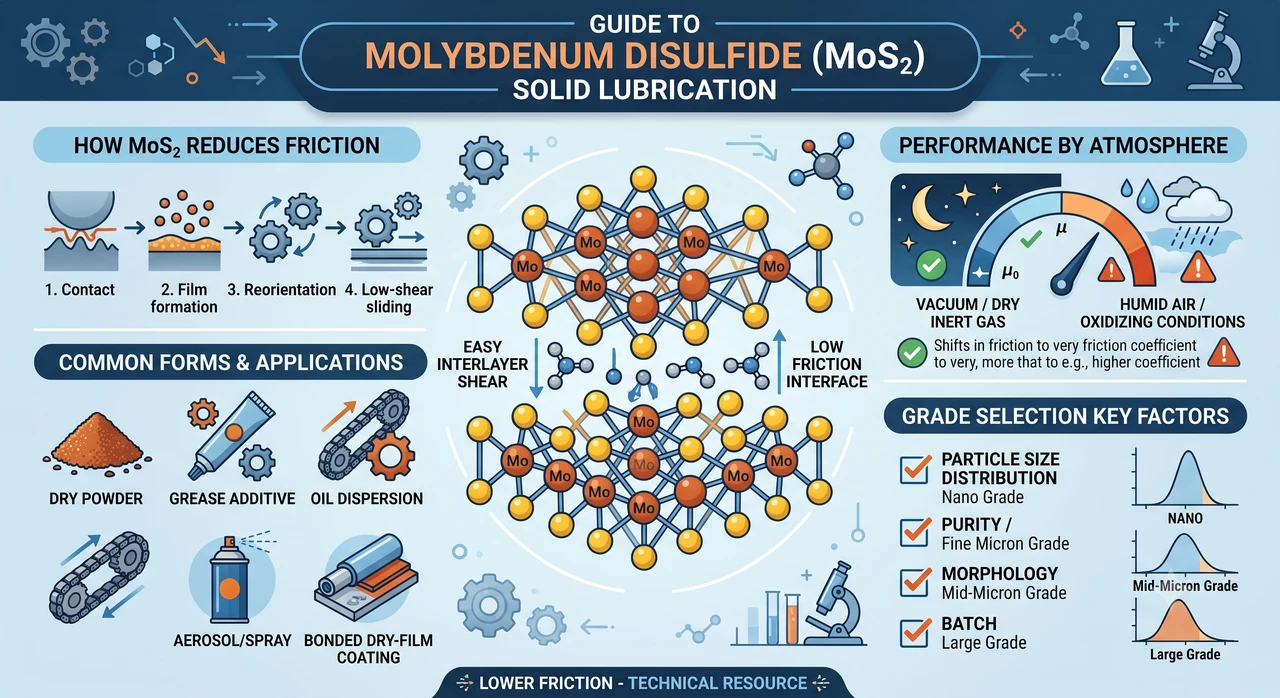
A useful way to think about MoS₂ is not simply “a slippery powder,” but as a material that can create a low-shear interface between contacting surfaces. When MoS₂ is present at the contact, lamellae can orient parallel to the direction of sliding and contribute to a transfer film. Sliding then occurs partly within or between MoS₂-rich layers rather than as direct metal-to-metal contact.
| 1 | Contact Surface asperities approach one another under load. |
| 2 | Film formation MoS₂ adheres or is carried into the contact and forms a solid lubricating layer. |
| 3 | Reorientation Sliding can align lamellae so basal planes become more favorable for shear. |
| 4 | Low-shear sliding Relative motion occurs through the MoS₂-rich interface, reducing direct adhesive contact. |
One “coefficient of friction” number is not enough
The International Molybdenum Association (IMOA) gives 0.03–0.06 as a representative low-friction range for MoS₂. But controlled coating studies show how strongly atmosphere can shift the result.
| Environment | Test condition | Dynamic friction coefficient (µ) |
|---|---|---|
| High vacuum | 10⁻⁵ Pa |
|
| Helium | Controlled gas |
|
| Argon | Controlled gas |
|
| Dry air | Controlled gas |
|
| Water vapor | Controlled gas |
|
How to read this table
These values come from a 2025 study of a specific MoS₂-coated steel system and are not universal design constants. Their value is the trend: dry/inert/vacuum conditions can produce much lower friction than water-rich or oxidizing environments. For engineering selection, use data from the actual coating, substrate, load and atmosphere you plan to run.
How humidity, oxygen and temperature change MoS₂ performance
MoS₂ is often described as a high-temperature lubricant, but this statement needs context. The material can remain chemically stable to very high temperatures under vacuum or inert conditions, while an MoS₂ lubricating film in air can lose performance much earlier because water adsorption and oxidation change the sliding interface.
| Environment | Typical trend | Why |
|---|---|---|
| High vacuum / dry inert gas | Generally favorable for low friction | Low water/oxygen exposure supports easy shear; coating structure and transfer film still matter. |
| Humid air at lower temperatures | Friction and wear can increase | Adsorbed water interacts with defects/edge sites and can hinder formation of a low-shear interface. |
| Air above ~373 K (100 °C) | Oxidation becomes increasingly important in literature reviews | MoO₃ formation and microstructural changes can raise friction and wear. |
| Air at higher temperatures | Performance becomes coating- and formulation-specific | Some studies show strong friction increases above ~473 K (200 °C); dopants and binders can shift behavior. |
| Vacuum/inert gas, moderate temperatures | Often maintains low friction over a broader range | A 2025 review found relatively small temperature effects across many tests from 220–540 K, while high-temperature data remain more limited. |
So what is the “temperature limit” of MoS₂?
There is no single temperature limit that applies to every MoS₂ product. IMOA cites effective lubrication from cryogenic temperatures to about 350 °C in air and up to about 1200 °C in inert or vacuum conditions. Those figures describe broad material capability, not guaranteed performance for every powder, bonded film, spray or grease.
A 2025 review of dry-film lubricants found that water adsorption is an important limitation at lower temperatures in air, while oxidation becomes increasingly important as temperature rises. In other words, melting point is the wrong number to use when specifying a lubricant: the practical limit is usually set by the complete tribosystem long before bulk MoS₂ reaches its reference melting point.
What forms does MoS₂ come in?
| Form | Typical role | What changes the result |
|---|---|---|
| Dry powder | Direct dry lubrication, formulation, metalworking, research | Particle size, purity, morphology, surface preparation |
| Grease additive | Boundary/extreme-load support in a grease matrix | Base grease, dispersion, concentration, compatibility |
| Oil dispersion | Particulate friction/wear additive | Sedimentation, filtration, dispersant package, particle size |
| Soluble molybdenum additive | Oil-soluble friction modifier / antiwear chemistry | Not the same thing as suspended MoS₂ powder |
| Bonded dry-film coating | Persistent solid lubricating film | Binder, cure, film thickness, adhesion, atmosphere |
| Aerosol / spray | Convenient applied lubricant film | Carrier, binder, solids content, dry-film behavior |
| Polymer/composite additive | Tribological modification of bulk material | Dispersion, processing, surface finish, counterface |
| Thin film / 2D material | Electronics, sensing, catalysis and research | Phase, layer count, defects; different specification logic from lubricant powders |
How much MoS₂ is used in formulations?
There is no safe universal dosage. IMOA publishes historical formulation examples using molybdenum content as the reporting basis. They are useful for understanding how widely formulation levels can vary, but they are not a recipe for a new product.
| Example product type | IMOA example range* | Example use |
|---|---|---|
| Greases | 1–20% Mo content | Bearings, splines, chassis, conveyors |
| Pastes | 20–60% Mo content | Assembly, gears, joints, metal forming |
| Industrial / motor oils | 0.5–5% Mo content | Gears, reducers, cams |
| Water suspensions | 1–20% Mo content | Metalworking, threads, die casting |
| Bonded coatings | Up to 85% Mo content | Tools, valves, slides, metalworking |
| Metalworking compounds | 1–40% Mo content | Extrusion, cold forming, wire drawing |
| Pure or mixed powders | 10–100% Mo content | Punching, stamping, forming and related uses |
*IMOA reports these example formulation ranges as molybdenum content, not a universal MoS₂ dosage. Finished formulations should be validated by tribological and compatibility testing.
MoS₂ powder grades: what actually defines a grade?
Terms such as “fine,” “superfine,” “technical grade” or “nano” are not enough to compare two MoS₂ powders. A useful specification should explain how particle size was measured and should include the variables that can change film formation, dispersion and finished-part behavior.
| Specification field | What to verify |
|---|---|
| Particle size distribution | Ask whether the number is D10, D50, D90, a top size or a nominal/average value. |
| Purity / composition | Confirm the product specification and certificate of analysis rather than assuming all “MoS₂” powders are equivalent. |
| Morphology | Platelet shape, agglomeration and surface area influence dispersion and film behavior. |
| Crystal phase / structure | Important for research and electronic applications; lubricant-grade material is usually specified differently. |
| Surface treatment / additives | Treated or blended powders can behave differently from untreated MoS₂. |
| Batch documentation | SDS, technical data and CoA help distinguish a repeatable grade from a generic powder listing. |
D50 is not “the particle size”
If a supplier reports D50 = 4.5 µm, that means the median of a measured particle-size distribution under the stated method. It does not mean every particle is 4.5 µm. For tight clearances, filters or thin films, D90/top-size information can be more important than D50 alone.
Current Lower Friction MoS₂ powder sizes
90 nm
Listed in product brochure; confirm current stock
Nano-scale selection requires careful dispersion/agglomeration control.
1.5 µm
Current category listing
Fine micron grade; verify measurement basis, film requirement and carrier compatibility.
4.5 µm
Current category listing
Mid-micron option; verify clearances, filtration and dispersion requirements.
12.5 µm
Current category listing
Larger listed grade; verify surface finish, application method and system tolerance.
For live product availability, pack sizes and purchasing information, see Lower Friction’s MoS₂ powder category.
How to choose an MoS₂ powder grade without over-specifying it
Particle size matters, but it should be selected alongside the application. A smaller nominal size is not automatically “better.” Finer powders can help when a thin, smooth distribution is needed, but they may also be harder to disperse and can agglomerate. Larger particles can be easier to handle in some processes but may be unsuitable for very thin films, tight clearances or fine filtration.
| Selection question | Information to provide |
|---|---|
| 1. Where will the MoS₂ go? | Dry surface, grease, oil, coating, polymer, metalworking process or research sample? |
| 2. What is the contact? | Substrate, counterface, roughness, clearance, contact pressure and sliding mode. |
| 3. What is the environment? | Air, humidity, inert gas, vacuum, radiation, contamination constraints. |
| 4. What temperature matters? | Bulk temperature plus likely flash/contact temperature; include start-up and storage conditions. |
| 5. How will it be delivered? | Burnished powder, dispersion, grease, sprayed film, bonded coating or compounded material. |
| 6. What size metric is specified? | D10/D50/D90, top size, nominal size, primary particle size and test method. |
| 7. What documentation is required? | SDS, TDS, CoA, batch traceability and any application-specific compliance. |
MoS₂ vs other common solid lubricants
No solid lubricant wins in every environment. The correct comparison starts with the failure mode you are trying to avoid: humidity sensitivity, oxidation, electrical conductivity, load, temperature, chemical compatibility or film thickness.
| Material | Where it is often considered | Main selection question |
|---|---|---|
| MoS₂ | Dry/vacuum lubrication, boundary contacts, coatings and additives | Humidity and oxygen can raise friction/wear; system-specific temperature limits |
| Graphite | Air environments where adsorbed species support lubricity | Can lose lubricity in high vacuum because moisture is absent |
| WS₂ | Low-friction/high-load solid lubrication and specialty coatings | Cost, grade availability and application-specific performance |
| hBN | High-temperature / electrically insulating applications and release | Different load/friction behavior from transition-metal dichalcogenides |
| PTFE | Polymeric low-friction additive, coatings and dry-lube formulations | Temperature, creep/load response and binder/system compatibility |
Why MoS₂ and graphite behave differently in vacuum
Graphite typically relies more strongly on adsorbed environmental species for low friction. MoS₂ can retain low friction in dry or vacuum conditions, which is one reason it has a long history in aerospace and vacuum mechanisms. This does not mean every MoS₂ coating will have the same wear life in space; coating microstructure, contamination and storage history still matter.
Four MoS₂ specification myths that cause avoidable errors
When MoS₂ may not be the best starting point
- ✕The application runs continuously in humid or water-rich conditions and no environmental-resistant coating/formulation has been validated.
- ✕The system requires an electrically insulating solid lubricant; conventional 2H-MoS₂ is a semiconductor, not an insulating ceramic like hBN.
- ✕Very fine filtration or micro-clearances cannot tolerate the selected particulate size distribution.
- ✕The process needs heat removal from the contact; a solid lubricant does not provide the same convective cooling function as a circulating liquid lubricant.
- ✕The binder, carrier oil, grease thickener or polymer matrix is incompatible with the selected MoS₂ grade.
- ✕The application is safety-critical and the only available performance number comes from an unrelated test method or atmosphere.
MoS₂ beyond lubrication
MoS₂ is also a major two-dimensional material in electronics and materials research. The stable 2H phase is semiconducting, while the metastable 1T phase shows metallic behavior. Layer count and crystal phase can therefore change electrical and optical properties significantly. These topics matter for thin films, sensors, catalysis and energy-storage research, but they should not be used as a shortcut for specifying an industrial lubricant powder: a tribology grade is normally selected around particle, formulation and surface-performance requirements.
A better way to request an MoS₂ powder recommendation
Instead of asking a supplier for “the best MoS₂ grade,” send the operating information below. It reduces trial-and-error and makes it easier to compare grades on the same basis.
| Send this information | Example of the useful detail |
|---|---|
| Application | Dry burnishing, grease additive, oil dispersion, bonded coating, composite, forming process |
| Contact pair | Steel/steel, steel/polymer, alloy/ceramic, etc. |
| Atmosphere | Ambient air, RH range, dry nitrogen, high vacuum |
| Temperature | Normal operating + peak/contact temperature |
| Clearance / filtration | Minimum clearance, filter rating, acceptable maximum particle size |
| Carrier / binder | Oil viscosity/base stock, grease chemistry, resin or solvent system |
| Target quantity | Lab trial, pilot batch or production volume |
| Documentation | SDS, TDS, CoA, particle-size report, batch traceability |
Frequently asked questions about MoS₂
What does MoS₂ stand for?
MoS₂ is the chemical formula for molybdenum disulfide: one molybdenum atom combined with two sulfur atoms.
Why is MoS₂ used as a lubricant?
Its layered S–Mo–S structure can form a low-shear interface and transfer film between contacting surfaces. This reduces direct asperity contact and can lower friction and wear, especially under dry, boundary or vacuum conditions.
What is the coefficient of friction of MoS₂?
There is no universal value. IMOA gives 0.03–0.06 as a representative range, while published coating tests range from about 0.01 in high vacuum to much higher values in water-rich or oxidizing conditions. Always compare values under relevant test conditions.
Does MoS₂ work in vacuum?
Yes. MoS₂ is widely used as a solid lubricant in vacuum and space mechanisms because its low-friction behavior does not depend on atmospheric moisture in the same way graphite does.
What temperature can MoS₂ withstand?
It depends on atmosphere and lubricant form. IMOA cites roughly 350 °C in air and up to about 1200 °C in inert/vacuum conditions as broad material-use references, but individual coatings and formulations can lose performance at lower temperatures. Use product-specific test data.
Is MoS₂ soluble in water?
Bulk molybdenum disulfide is reported as insoluble in water. That does not mean a powder automatically disperses well in water; a stable suspension may require dispersants and formulation work.
Is MoS₂ conductive?
The common 2H phase is semiconducting, while 1T-MoS₂ is metallic. Electrical behavior also depends on layer count, defects and processing, so generic lubricant powder should not be assigned a single “conductive/nonconductive” label without a specification.
Is molybdenite the same as MoS₂?
Molybdenite is the naturally occurring mineral composed principally of MoS₂. Industrial MoS₂ powders are processed and specified materials rather than simply untreated ore.
Is nano MoS₂ better than micron MoS₂?
Not automatically. Nano material can provide high surface area and fine films, but it can be more difficult to disperse and may agglomerate. Micron grades can be more practical in many industrial formulations. The correct choice depends on film thickness, carrier, clearance and process.
Can MoS₂ powder be added directly to grease or oil?
MoS₂ is used in greases and oil dispersions, but “add directly” is not a universal formulation method. Concentration, dispersion stability, base-fluid chemistry, filtration and additive interactions should be validated in the finished lubricant.
How do I choose between 1.5, 4.5 and 12.5 µm MoS₂ powder?
Start with the required film/clearance, how the powder will be dispersed or applied, filtration limits and surface finish. Then compare the supplier’s particle-size distribution and test a candidate grade under the intended operating conditions.
Need MoS₂ powder rather than the technical guide?
Compare current micron grades, product documentation and ordering options on the Lower Friction MoS₂ powder page.
View MoS₂ Powder GradesTechnical references
- PubChem – Molybdenum disulfide (CID 14823): molecular formula, molecular weight, CAS, density, solubility and reference physical properties. Open source
- International Molybdenum Association (IMOA) – Molybdenum-sulfur compounds in lubrication: friction range, lubricant forms, temperature references and formulation examples. Open source
- NASA Technical Reports Server – Friction and Wear Properties of Selected Solid Lubricating Films: MoS₂ testing in ultrahigh vacuum, humid air and dry nitrogen. Open source
- Coatings (2025) – Frictional Behavior of MoS₂ Coatings: controlled comparison of vacuum, helium, argon, dry air and water-vapor friction. Open source
- Tribology Letters (2025) – Temperature-Dependent Friction, Wear, and Life of MoS₂ Dry Film Lubricants for Space Mechanisms: review of temperature, humidity and oxidation effects. Open source
- ScienceDirect review – MoS₂ crystal phases and structure: 1T, 2H and 3R. Open source
- Lower Friction – Molybdenum Disulfide (MoS₂) Powder: current commercial particle-size listings and product availability notes. Open source
This article offers general technical information, not application-specific engineering or safety advice. Results are dependent on product, material, method, equipment and operating conditions. Check the current SDS, TDS and product instructions, test a small sample first and assess suitability for wider use. Read the full Technical Information and Use Disclaimer.