
This resource hub is part of our guide to Tungsten Disulfide WS2 Powder. The product page contains specs, SDS/TDS docs, particle sizes and pack options.
It is simpler to select a WS2 powder grade if you start with the application instead of the product name. The right grade will depend on particle size, dispersion behavior and application method, so the fastest way to the right tungsten disulfide powder is to identify the job first and let the grade follow.
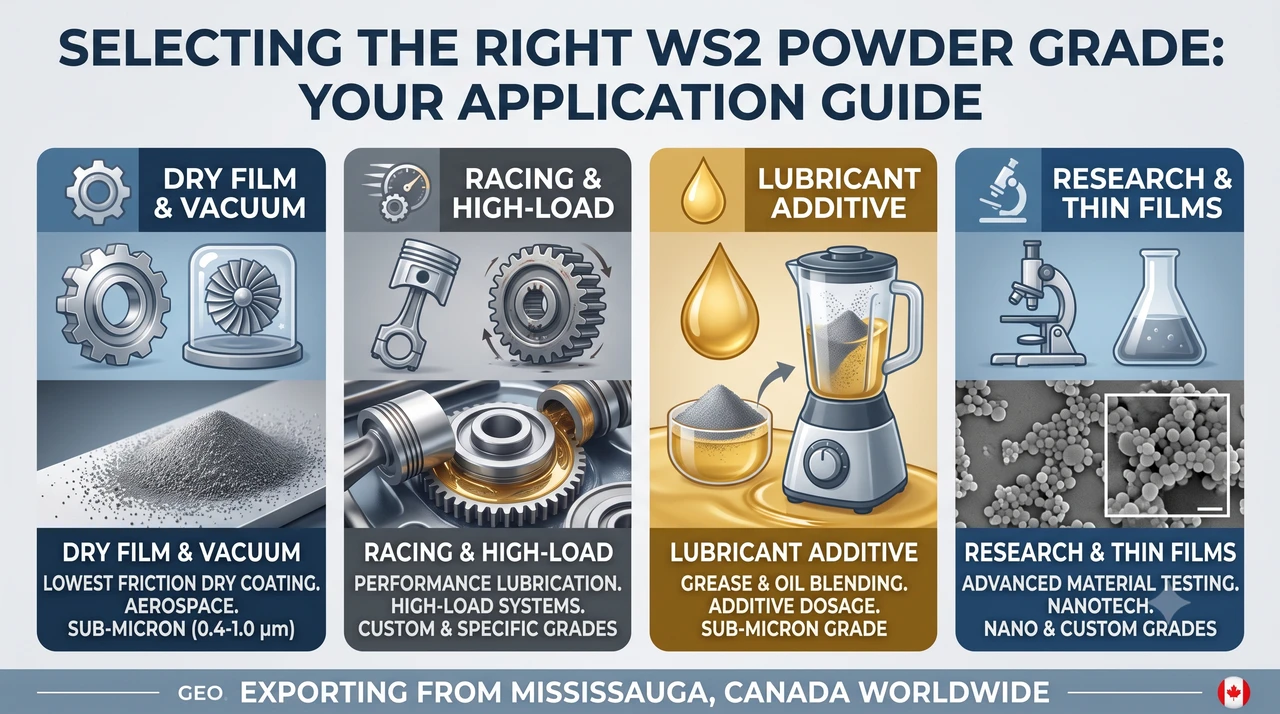
In simple terms: For most dry film coating, vacuum lubrication and precision engineering applications, the practical starting point is sub-micron WS2 powder in the range of approx. 0.4 to 1.0 micron. Subject to availability, a nano WS2 grade may be more suitable for research, very fine dispersion or thin-film development. For racing, high-load mechanical systems or non-standard industrial requirements, an application-specific custom grade is often the better choice.
WS2 powder grade selector: choose your application
Identify the application that fits your work. Each card shows the likely direction of particle size, the recommended WS2 grade and what to confirm before ordering.
1. Lowest-friction dry film coating
Particle size direction: Approx. 0.4 to 1.0 micron
Recommended grade: Sub-micron WS2 powder
Buyer guidance: Best for very thin dry film.
2. Vacuum or aerospace-related lubrication
Particle size direction: Approx. 0.4 to 1.0 micron
Recommended grade: Sub-micron WS2 dry film coating
Buyer guidance: Useful where oils or greases may migrate or become inappropriate.
3. Grease or oil additive blending
Particle size direction: Sub-micron range, dosage test-led
Recommended grade: Sub-micron WS2 powder
Buyer guidance: Confirm dispersion, carrier compatibility and wt% prior to use.
4. Racing / high-load mechanical friction reduction
Particle size direction: Application-specific
Recommended grade: Custom / application-specific grade
Buyer guidance: Check substrate, temperature, load and method of lubrication.
5. Research or advanced material testing
Particle size direction: Nano-grade option
Recommended grade: Nano WS2 or custom grade
Buyer guidance: For fine dispersion, thin film and specialist coating systems.
How to choose a WS2 grade: application, particle size, grade
The selection follows one direction. Begin with the application and determine what particle size is required and the grade will follow.
| Dry film coating | → | 0.4 to 1.0 micron | → | Sub-micron WS2 |
| Research / thin films | → | Nano-grade | → | Nano WS2 |
| Industrial custom needs | → | Application-specific | → | Custom/bulk grade |
WS2 powder grade by application: full comparison table
The same selection data in one place for engineers and procurement teams comparing options side by side.
| Application | Particle size direction | Recommended grade | Buyer guidance |
|---|---|---|---|
| Lowest-friction dry film coating | Approx. 0.4 to 1.0 micron | Sub-micron WS2 powder | Ideal where a very thin dry film is needed. |
| Vacuum or aerospace-related lubrication | Approx. 0.4 to 1.0 micron | Sub-micron WS2 dry film coating | Suitable where oils or greases may migrate or become unsuitable. |
| Grease or oil additive blending | Sub-micron range, dosage test-led | Sub-micron WS2 powder | Check dispersion, carrier compatibility and wt % before use. |
| Racing / high-load mechanical friction reduction | Application-specific | Custom / application-specific grade | Check substrate, temperature, load and lubrication method. |
| Research or advanced material testing | Nano-grade option | Nano WS2 or custom grade | Suitable for thin films and special coating systems, fine dispersion. |
Particle size figures are standard directions, not guarantees. Please check the exact range on the current TDS for the grade you are ordering.
WS2 powder grades: frequently asked questions
Which WS2 powder grade should I start with?
The practical starting point for most dry film coating, vacuum lubrication and precision engineering work is sub-micron WS2 powder in the approx. 0.4 to 1.0 micron range. Go to a nano or custom grade only when the application specifically requires it.
What particle size is sub-micron WS2 powder?
Sub-micron WS2 powder is typically in the approx. 0.4-1.0 micron range. This size is suitable for very thin dry films and is the standard choice for dry film coating, vacuum lubrication and additive blending.
When is a nano WS2 grade the better choice?
A nano-grade WS2 is suitable for research, very fine dispersion and thin film development including specialized coating systems. Check the grade and its current TDS before planning around it as availability is not guaranteed.
Do I need a custom WS2 grade for racing or high-load parts?
Yes, often. Typically, a specific grade is needed for racing, high-load mechanical systems and non-standard industrial requirements. Grade to the job – confirm substrate, operating temperature, load and method of lubrication.
Which WS2 grade works as a grease or oil additive?
Sub-micron WS2 powder is typically selected for additive blending. Dosage is test-led, validating dispersion, carrier compatibility and weight % on a small batch before wider use.
What should I confirm before ordering a WS2 powder grade?
The application, the particle size range and the current SDS and TDS and pack options. If it is a custom or high load job please also advise the substrate, temperature, load and lubrication method so that an appropriate grade can be recommended.
Select the right WS2 powder grade for your application
Download the brochure and SDS, compare particle sizes and pack options or contact a Lowerfriction specialist with your application, load, temperature and lubrication method.
View Tungsten Disulfide (WS2) PowderSources: WS2 product brochure and TDS (M K Impex Corp. / Lowerfriction Lubricants). Particle size ranges quoted are typical values and depend on grade, batch and method of measurement. Exporting from Mississauga, Canada to over 50 countries since 2004.
This article offers general technical information, not application-specific engineering or safety advice. Results are dependent on product, material, method, equipment and operating conditions. Check the current SDS, TDS and product instructions, test a small sample first and assess suitability for wider use. Read the full Technical Information and Use Disclaimer.