
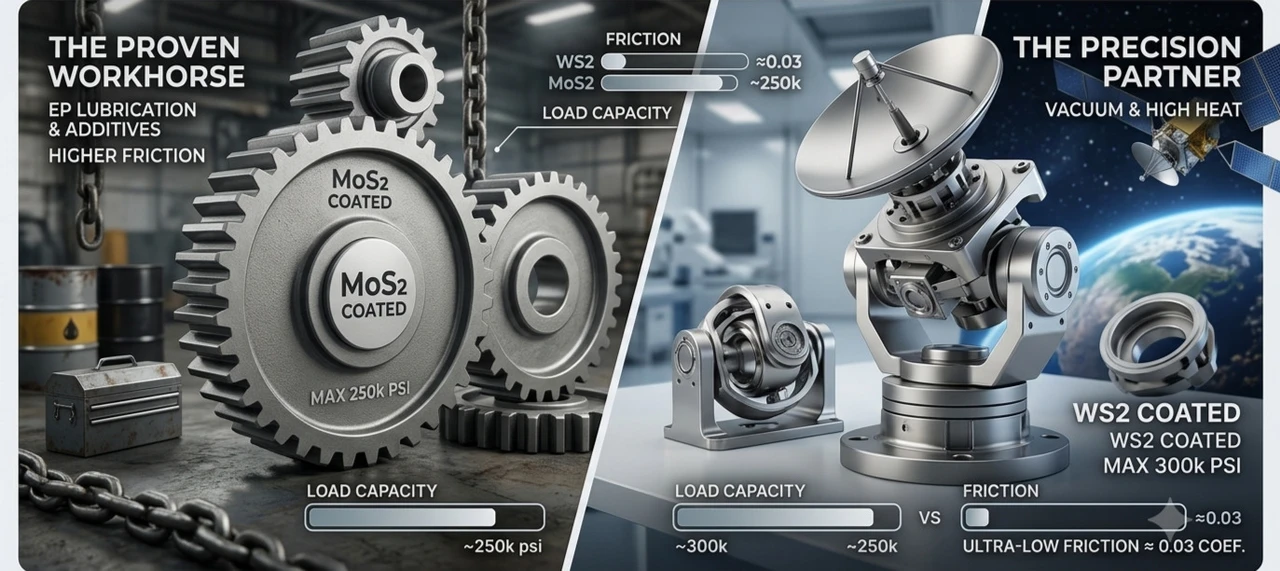
Tungsten disulfide (WS2) and molybdenum disulfide (MoS2) are the two most widely used solid lubricants in industry. Both share the same layered crystal structure, which is what lets surfaces slide with very little resistance, but they behave differently under load, heat and vacuum. This guide compares the two and explains which one suits which application.
WS2 vs MoS2: which one fits your job?
If you need a quick decision, this is the split. The reasons behind it are covered in the property-by-property comparison that follows.
Vacuum systems, heavily loaded contacts, parts running at very high temperatures and precision components, wherever the lowest possible friction and a strong dry film matter most.
Everyday extreme-pressure lubrication and additive use. It blends well into greases and oils and works as a general dry-film coating on chains, gears, threads and EP wear points throughout a plant.
WS2 and MoS2: Property-by-Property Comparison
Each property below places the two lubricants side by side. The bars are a visual indication only; the figures are typical values for coated films and will vary with film quality, surface finish and operating conditions.
Friction: lower is better
A shorter bar means less friction. WS2 has one of the lowest coefficients of friction of any solid lubricant (around 0.03), which is why it is preferred for precision and low-drag applications.
Load bearing: higher is better
A longer bar means a higher supported load. A WS2 coated film carries about 20 per cent more load than MoS2, which matters in tooling, metal forming and any contact under very high load.
Temperature
WS2 is the stronger choice where high temperature combines with heavy load or vacuum. Refer to the brochure or TDS for the exact temperature range of the specific product, as the limits differ between powders, sprays and films.
Vacuum suitability
Dry films do not migrate or evaporate in vacuum, whereas oils and greases do. That is why both WS2 and MoS2 are used throughout aerospace and vacuum equipment. Where a part also needs the lowest possible friction, WS2 has the edge.
WS2 vs MoS2 at a glance
The two key figures and the best-fit application for each material.
MoS2 is higher, depending on the film and conditions
About 20% more load capacity for WS2
- WS2: vacuum, high-load, precision work
- MoS2: broad EP lubrication and additives
WS2 vs MoS2 comparison table
Typical values for coated films. Actual figures depend on film quality, surface finish, load, speed, temperature and environment. Test on a small batch of your own parts before committing to production.
| Property | WS2 (Tungsten Disulfide) | MoS2 (Molybdenum Disulfide) |
|---|---|---|
| Primary benefit | Ultra-low friction and very high load-bearing as a coated film | Time-tested solid lubricant for extreme-pressure lubrication and additives |
| Dynamic friction | Approx. 0.03 | Higher than WS2; depends on conditions |
| Static friction | Approx. 0.07 | Varies with film and test conditions |
| Load-bearing ability | Up to approx. 300,000 psi | Up to approx. 250,000 psi |
| Vacuum suitability | Excellent | Excellent in inert and high-vacuum settings |
| Best fit | Vacuum, high-load and precision applications | Broad EP lubrication and additive applications |
WS2 vs MoS2: frequently asked questions
+Which is better, WS2 or MoS2?
It depends on the job. WS2 is the better choice for the lowest friction, the highest coated-film loads, vacuum and high heat. MoS2 is the better choice where a proven, economical EP lubricant or additive is all that is required.
+Does WS2 have lower friction than MoS2?
Yes, in most cases. WS2 has a dynamic coefficient of about 0.03 and a static coefficient of about 0.07, among the lowest of any solid lubricant. MoS2 is generally higher, although the gap depends on film quality and test conditions.
+Which is better for vacuum, WS2 or MoS2?
Both perform very well in vacuum, where oils and greases evaporate or migrate. WS2 is the choice when the same part also needs the lowest friction; MoS2 is a well-established option in inert and high-vacuum environments.
+Which is the better grease or oil additive?
MoS2 is the traditional choice and has been used in EP greases and oils for decades. WS2 is worth considering when lower friction and higher load capacity justify its cost. In either case, confirm compatibility with the base lubricant and the blend ratio first.
+Can I use both WS2 and MoS2 in the same plant?
Yes, many maintenance teams do. MoS2 covers the everyday EP lubrication points, and WS2 is reserved for the vacuum, high-load and precision contacts where its lower friction and higher load capacity are worth the cost.
+What should I ask a supplier for before ordering?
The current brochure and SDS, the available grades and particle sizes, and the pack options. If you are unsure which grade suits your application, share your load, temperature, atmosphere and application method, and a good supplier will be able to recommend the right one.
Compare WS2 and MoS2 for your application
Download the brochures and SDS, compare particle sizes and pack options, or contact a Lowerfriction specialist with your load, temperature, vacuum and additive requirements.
Sources: WS2 and MoS2 product brochures (M K Impex Corp. / Lowerfriction Lubricants). Friction and load-bearing figures quoted for coated films are typical manufacturer values and depend on film condition, test method and operating conditions. Exporting from Mississauga, Canada to 50+ countries since 2004.
This article provides general technical information, not application-specific engineering or safety advice. Results vary with product, materials, methods, equipment and operating conditions. Review the current SDS, TDS and product instructions, test a small sample first, and confirm suitability before wider use. Read the full Technical Information and Use Disclaimer