
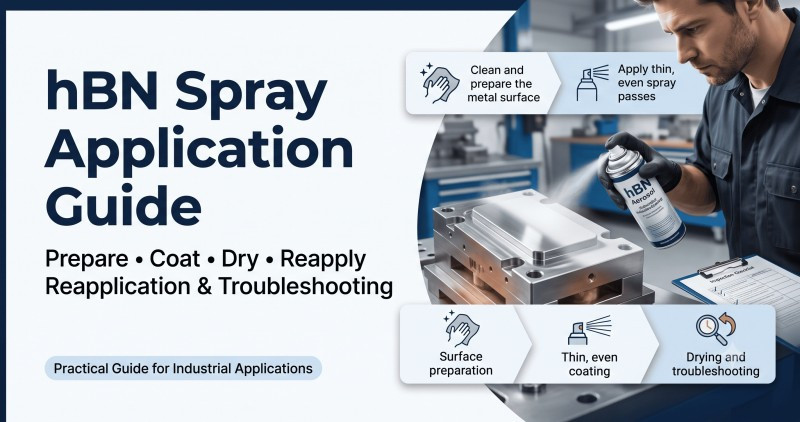
A practical application reference for engineers, maintenance teams and procurement professionals: surface preparation, coating, drying, reapplication planning, and symptom-based troubleshooting. Reviewed against the MK-hBN-SP Safety Data Sheet (Version 01, April 13, 2021 — current revision) and the product brochure.
Why hBN spray can underperform in real applications
A symptom-to-cause guide showing the first application variables to inspect. Many of these problems can be reduced through controlled preparation, application and validation.
| Failure mode | Likely cause | First item to inspect | Preventive stage |
|---|---|---|---|
| Peeling / flaking film | Oil, moisture, loose oxide or an unstable previous coating under the film | Substrate cleanliness — use a compatible cleanliness-verification method, such as a water-break test where suitable for the substrate and process | Step 1 — surface preparation |
| Powdery, low-cohesion film | Excessive film build, or dry overspray from an unsuitable spray distance | Film build per pass and spray distance vs the product label | Step 2 — coating technique |
| Weak adhesion from day one | Handled or placed into service before the film had fully dried | Drying time used vs the current product instructions | Step 3 — drying |
| Sticking returns mid-run | The sacrificial film has worn through before the reapplication point | Cycle count since last coat vs the trial-validated interval | Step 4 — reapplication planning |
| Rapid wear-through | Severe sliding or extreme-load duty that thin aerosol films may not support | Load/contact conditions vs the intended duty of a thin dry film | Product selection stage |
Thin aerosol films behave differently from bulk hBN ceramic or hBN powder; do not generalise a single friction or wear value across applications. Confirm performance under the actual process conditions.
Step 1 — Surface preparation checklist
Surface preparation is a critical factor affecting coating adhesion. Complete every preparation check that applies to the substrate and process before coating. Basis: general dry-film application guidance; SDS handling requirements where noted.
Step 2 — Coating technique
Film build is an important variable affecting coating cohesion and coverage. Use thin, even passes rather than one heavy application. Application requirements may vary with substrate, temperature, ventilation and intended duty.
Coverage gaps — no continuous film; release or lubrication performance may decline prematurely
Uniform, matte white, continuous coverage from thin, even passes
Powdery surface, reduced cohesion, higher risk of flaking in service
| Parameter | Guideline | Basis |
|---|---|---|
| Can condition | Shake thoroughly before and during use so the hBN particles remain evenly dispersed. | Product label/TDS; general aerosol application guidance |
| Spray distance | Follow the spray distance stated on the current product label or TDS. Too close risks wet, uneven build; too far risks dry, powdery overspray. | Product label / TDS |
| Passes | Use thin, even passes rather than one heavy application, keeping coverage continuous over edges, radii and shadowed features. | General dry-film application guidance |
| Between passes | Allow each pass to flash off in accordance with the current product instructions before applying the next; trapped solvent can cause blisters and pinholes. | Product instructions; general guidance |
| Environment | Well-ventilated area only; no ignition sources; ground all handling equipment; no smoking while using or until the sprayed surface is thoroughly dry; wear PPE per the SDS. | Current SDS |
Step 3 — Drying before handling and service
Confirm the required drying time from the current TDS or product label and validate it on a test piece. Drying depends on film build, temperature and ventilation.
| Stage | What to do | Risk if skipped | Basis |
|---|---|---|---|
| Flash-off | Allow the volatile carrier to evaporate between passes, per the current product instructions; the surface should turn uniformly matte. | Soft, smearable film; trapped solvent | General guidance |
| Full drying | Leave the coating until thoroughly dry before handling or service. The SDS requires no smoking while using or until the sprayed surface is thoroughly dry. Confirm the drying time from the current TDS and validate on a test piece. | Marking, transfer, reduced adhesion; residual flammable vapour | Current SDS; TDS |
| First heat-up (hot processes) | Where the process allows, raise the temperature gradually on the first cycle so any residual volatiles escape slowly. Validate the heat-up profile in a production trial. | Blistering or pinholes from rapid outgassing | General guidance; production trial required |
Step 4 — Reapplication planning
The film is sacrificial — it wears in service. Schedule reapplication before release or lubrication performance becomes unacceptable, rather than reacting to failures in production.
| Duty profile | Typical examples | Reapplication indicator | Planning approach |
|---|---|---|---|
| Light — static release | Setter plates, trays, fixtures | Visible thinning / substrate showing through | Inspect on a fixed schedule; recoat when the inspection criteria are not met |
| Moderate — cyclic release | Glass & ceramic molds, die-cast dies | First signs of sticking or marking on parts | Recoat at a cycle interval established through a monitored trial |
| Moderate — spatter protection | Weld nozzles, tips, fixtures | Spatter begins to adhere instead of flaking off | Establish the reapplication point through a monitored trial based on spatter adhesion, operating time and inspection results |
| Severe — sliding contact | Loaded ways, gears, threads under high load | — | Thin aerosol hBN films may not be suitable for severe sliding or extreme-load duty. Compare MoS₂, WS₂ or engineered bonded coatings and validate the selected system under the intended conditions. |
Production-trial record
Coating performance must be recorded under the actual process conditions before the product is adopted in production. Use this record for each substrate and duty combination tested.
| Test variable | Recorded value |
|---|---|
| Substrate material | |
| Surface condition | |
| Cleaning method | |
| Abrasion or de-scaling method | |
| Ambient temperature | |
| Substrate temperature | |
| Number of passes | |
| Spray distance | |
| Pass overlap | |
| Time between passes | |
| Time before handling | |
| Time before production use | |
| Process temperature | |
| Process atmosphere | |
| Load/contact condition | |
| Number of cycles tested | |
| First sign of performance decline | |
| Initial preventive-reapplication interval | |
| Final validated interval |
Step 5 — Troubleshooting
Select the observed symptom. Possible causes are listed in the recommended inspection order.
+Film peels or flakes off
| Check | Likely cause | Corrective action |
|---|---|---|
| 1 | Residual oil, grease or old release agent on the substrate | Strip the film, clean the substrate using a compatible method, verify cleanliness, and recoat |
| 2 | Loose oxide, scale or an unstable previous coating underneath | Abrade to sound substrate, dust off, recoat |
| 3 | Coated onto a damp or cold, condensing surface | Dry fully and allow the substrate to reach a temperature that prevents condensation and is permitted by the current product instructions |
| 4 | Excessive film build from a single heavy application | Strip and rebuild using thin, even passes |
+Film is powdery / rubs off as dust
| Check | Likely cause | Corrective action |
|---|---|---|
| 1 | Excessive film build — the film cannot hold the particle load | Remove the excess; recoat using thin, even passes |
| 2 | Spray distance greater than the product label states — dry overspray landing as dust | Follow the spray distance stated on the current product label or TDS |
| 3 | Insufficient shaking before or during use — uneven particle delivery, especially near the end of the can | Shake thoroughly; use a fresh can for critical coats |
+Parts stick / release performance declines mid-run
| Check | Likely cause | Corrective action |
|---|---|---|
| 1 | Film worn through — reapplication interval too long for the duty | Recoat; establish a shorter preventive interval through a monitored trial |
| 2 | Coverage gaps in corners, radii and blind features | Angle the can to reach shadowed areas; confirm continuous coverage visually |
| 3 | Process conditions beyond what the film supports in that atmosphere | Compare the process conditions with the brochure ratings and confirm suitability through application testing |
| 4 | Contaminant transferring from the part side | Audit upstream lubricants and binders contacting the tool |
+Uneven film — streaks, sags or thin spots
| Check | Likely cause | Corrective action |
|---|---|---|
| 1 | Inconsistent spray distance or pass speed | Steady sweep at the label-stated distance, with consistent overlap between passes |
| 2 | Insufficient flash-off between passes (sagging) | Allow each pass to flash off in accordance with the current product instructions |
| 3 | Vertical surfaces coated too wet | Use lighter, more frequent passes |
+Blisters or pinholes after first heat-up
| Check | Likely cause | Corrective action |
|---|---|---|
| 1 | Solvent trapped under excessive film build | Thin, even passes with full flash-off; confirm the drying time from the current TDS before heating |
| 2 | Moisture in a porous substrate outgassing | Where compatible with the substrate, process and product instructions, pre-dry porous tooling to reduce trapped moisture. Validate the method on a test piece |
| 3 | First heat ramp too fast for residual volatiles to escape | Raise the first-cycle temperature gradually where the process allows; validate in a trial |
Frequently asked questions
+How many coats of hBN spray should I apply?
Use thin, even passes rather than one heavy application, and follow any pass count, spray distance and flash-off instructions on the current product label or TDS. Excessive film build reduces cohesion and can leave the coating powdery; requirements vary with substrate, temperature, ventilation and intended duty.
+How long before a coated tool can go into service?
Confirm the required drying time from the current TDS or product label and validate it on a test piece. The coating should be thoroughly dry before handling or service; the SDS also requires no smoking while using or until the sprayed surface is thoroughly dry. For hot processes, raising the first heating cycle gradually is general good practice and should be validated for your process.
+Why does the coating peel even though it was sprayed carefully?
When peeling occurs, first check for residual oil, moisture, loose oxide, unstable previous coatings or excessive film build. If any of these are present, strip the film, correct the surface, and recoat using thin, even passes.
+How often should hBN spray be reapplied?
There is no universal reapplication interval. Film life depends on temperature, atmosphere, contact pressure, load, cycle count, substrate and surface condition. Establish the interval through monitored production trials: record when coating performance begins to decline, set the initial preventive interval conservatively below that point, and refine it with further production data. Schedule reapplication before release performance becomes unacceptable.
+Can hBN spray be used on heavily loaded sliding parts?
Thin aerosol hBN films may not be suitable for severe sliding or extreme-load duty. Compare MoS₂, WS₂ or engineered bonded coatings and validate the selected system under the intended conditions. hBN may be suitable where a clean, electrically insulating, high-temperature dry film or release coating is required — confirmed through application testing.
Validate hBN spray before production
Get the TDS and SDS, order a trial can (single, box of 12, or carton of 48), or talk to a Lowerfriction specialist about your surface, temperature and reapplication requirements.
Sources: MK-hBN-SP product brochure and Safety Data Sheet, Version 01, issued April 13, 2021 (M K Impex Corp. / Lowerfriction Lubricants) — the current SDS revision. Temperature values are manufacturer-stated maximum ratings from the product brochure. Surface-preparation, application, drying and reapplication guidance reflects general practice for aerosol dry-film lubricants except where attributed to the SDS or product documentation, and must be confirmed against the current MK-hBN-SP label and TDS and validated under actual load, speed, temperature and atmosphere before production use. Exporting from Mississauga, Canada to 50+ countries since 2004. Product availability and regulatory suitability vary by country; buyers should confirm chemical-inventory, VOC, transport and workplace requirements before ordering or using the product.