
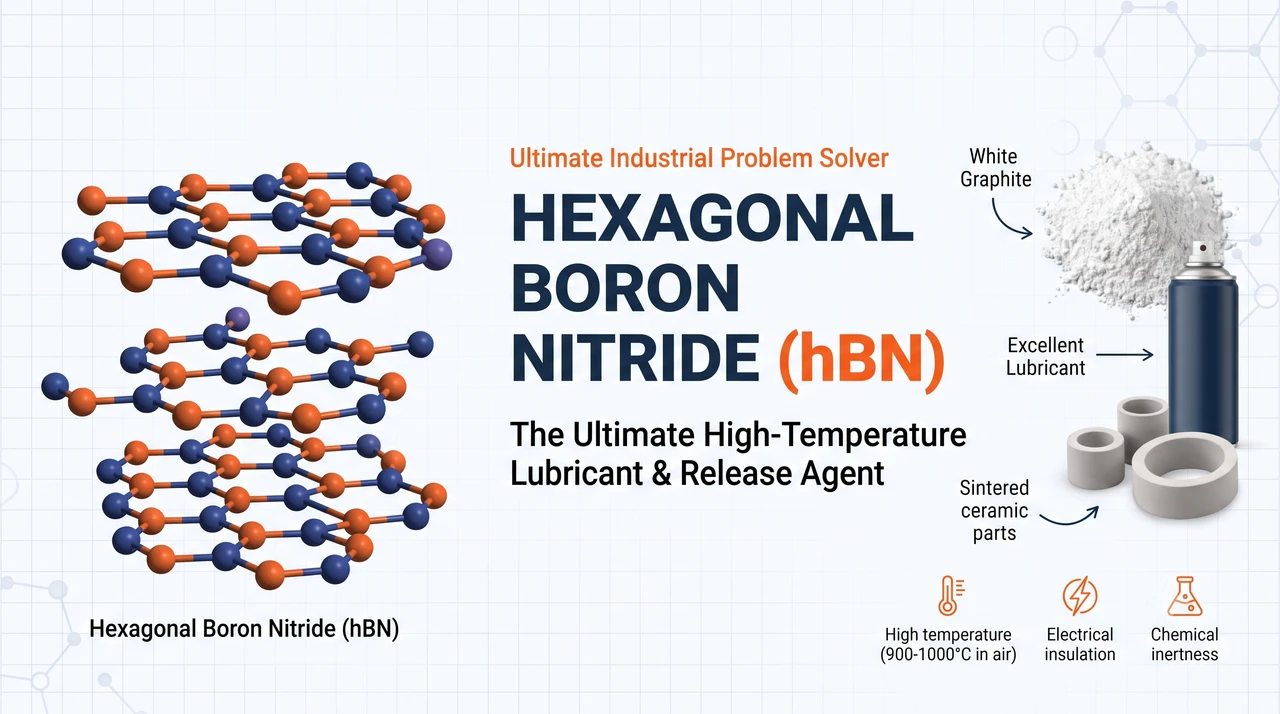
Hexagonal boron nitride (hBN) is a synthetic chemical compound of boron and nitrogen with chemical formula BN and a hexagonal layered crystal structure similar to graphite. It is white, electrically insulating, chemically inert and stable at high temperatures; thus it is often called "white graphite". In industry, hexagonal boron nitride is used as a high-temperature solid lubricant and release agent, as a thermally conductive but electrically insulating filler, and as a ceramic material for parts that come in contact with molten metal and glass.
This guide describes what hBN is, how its structure gives it its properties, the forms in which it is supplied and where it is used. If you already know the grade that you require, then you can head straight to our range of hexagonal boron nitride powder.
Hexagonal boron nitride at a glance
| Chemical name | Boron nitride, hexagonal boron nitride |
|---|---|
| Other names | hBN, h-BN, white graphite; "BN powder" is often used informally for hBN in industrial contexts |
| Chemical formula | BN |
| CAS number | 10043-11-5 |
| Molecular weight | 24.82 g/mol |
| Crystal structure | Hexagonal, layered |
| Appearance | White powder |
| Density | About 2.1 to 2.3 g/cm³ (about 2.29 g/cm³ for Lowerfriction grades) |
| Electrical behavior | Electrical insulator |
| Temperature stability | About 900 to 1000 °C in air, 1400 °C in vacuum and 1800 °C in inert gas (reported values; grade and conditions dependent) |
| Melting point | Does not melt at normal pressure; dissociates at about 3000 °C |
Note: Values are typical and vary with grade, purity, particle size, and test method. Always confirm the current specifications and Safety Data Sheet (SDS) that apply to the exact grade you are using.
The structure of hBN: why it is called "white graphite"
In hexagonal boron nitride, boron and nitrogen atoms alternate in flat, six-sided rings. The rings combine to form large, thin sheets, like the carbon sheets in graphite. Within each sheet, the atoms are held together by strong covalent bonds. The sheets are stacked on top of each other and are held together only by weak van der Waals forces.
This layered structure explains much of hBN’s behavior:
- Lubricity: the weakly bonded layers can slide over each other under shear, so hBN acts as a dry, solid lubricant.
- Platelet particles: hBN powders are made of thin, flat platelets rather than round grains.
- Directional properties: heat travels much more easily along the sheets than across them, so properties such as thermal conductivity depend on particle orientation.
The bonds are what differentiate it from graphite. The boron-nitrogen bonds are polar, meaning the electrons aren't moving freely through the sheet but rather stay close to the atoms. Accordingly, hBN is a wide band gap material (around 6 eV) and an electrical insulator, while graphite is conductive. The same bonding imparts to hBN a white color instead of black, and a much better resistance to oxidation in hot air.
Key properties of hexagonal boron nitride
High-temperature stability
Usually cited at around 900–1000 °C in air, with higher stability in vacuum or inert gas. Actual limits are dependent on grade, atmosphere, contact materials and exposure time.
Solid lubricity
Layered structure gives lubricity that is held at high temperature. Published values of dry friction (0.15-0.7) are higher than those of MoS₂ or WS₂; therefore hBN is used for heat and release rather than the lowest friction at room temperature.
Electrical insulation
hBN is an electrical insulator. Typical published values are dielectric strength around 35 kV/mm and dielectric constant around 4; values are dependent on grade and test method.
Thermal conductivity
Good conductor of heat, especially in the plane of the platelets.
Chemical inertness and non-wetting
It is resistant to most chemicals and not easily wetted by many molten metals, glass and slags, making it an effective release and parting material.
Thermal shock resistance
hBN has low thermal expansion, so parts and coatings can tolerate rapid heating and cooling.
Softness and machinability
hBN is soft. Sintered hBN shapes can be machined with common tools.
White and non-staining
It leaves surfaces light or clean, as opposed to graphite.
Hexagonal boron nitride vs other forms of boron nitride
Boron nitride has several crystalline forms. People searching for boron nitride powder for lubrication, release or thermal filler usually mean the hexagonal form.
| Form | Structure | Main characteristic | Typical use |
|---|---|---|---|
| Hexagonal (hBN, h-BN) | Layered, graphite-like | Soft, lubricious, insulating, stable at high temperature | Lubricants, release agents, thermal fillers, ceramics, cosmetics |
| Cubic (cBN, c-BN) | Diamond-like | Extremely hard, second only to diamond | Cutting tools and abrasives for hardened steels |
| Wurtzite (wBN) | Hexagonal but dense, diamond-like bonding | Very hard, rare, made under high pressure | Mainly research |
| Amorphous (aBN) | No long-range order | Used as an intermediate or thin-film material | Coatings and research |
Forms of hexagonal boron nitride used in industry
- Micron and submicron powders: The most common. Powders are used directly as a dry lubricant or release agent or mixed into coatings, polymers, greases and ceramics.
- Nanopowders: Very fine particles, such as about 70 nm, evaluated where smooth thin films, fine dispersions or composite research are needed. Related materials are listed in Nano lubricants.
- Aerosol sprays and coatings: Ready-to-use boron nitride coatings for release and anti-stick applications on tools, molds and dies. See boron nitride aerosol spray.
- Sintered and hot-pressed shapes: Solid hBN ceramics machined into crucibles, nozzles, insulators, setter plates and furnace parts.
- Fillers in composites: hBN platelets are added to polymers, resins, rubbers and thermal interface materials to conduct heat while maintaining electrical insulation.
- 2D hBN nanosheets: Single- or few-layer sheets studied as insulating substrates and barrier layers for advanced electronics applications.
How hexagonal boron nitride is made
Hexagonal boron nitride does not occur naturally in useful quantities, so it is produced synthetically. It was first synthesized in the 1840s, and commercial production began in the 20th century. A typical industrial route reacts a boron source, such as boric acid or boron oxide, with a nitrogen source, such as ammonia, urea or melamine, at high temperature. The resulting material is then heat-treated at a higher temperature to improve its crystallinity and purity. Process conditions, together with any subsequent milling or size classification, determine particle size, platelet shape, purity and oxygen content. This is why hBN powders from different manufacturers can behave quite differently.
Industrial uses of hexagonal boron nitride
| Industry or application | Role of hBN | Typical form |
|---|---|---|
| Metal casting and die casting | Release and parting agent that resists wetting by molten metal | Coating, spray, powder slurry |
| Glass manufacturing and forming | Mold release and protective coating in contact with hot glass | Coating, spray, sintered parts |
| Metal forming, forging and extrusion | High-temperature dry lubricant where oils burn off | Powder, coating |
| Welding and brazing | Anti-spatter and stop-off coating | Spray, coating |
| Polymers, electronics and thermal interface materials | Thermally conductive, electrically insulating filler | Powder |
| Lubricants and greases | Solid additive evaluated for high-temperature or specialty lubricants | Powder |
| Paints and coatings | High-temperature, release and low-friction coatings | Powder |
| Ceramics and refractories | Crucibles, insulators, thermocouple protection and furnace parts in contact with molten metal | Sintered or hot-pressed shapes |
| Cosmetics and personal care | Slip, smooth feel and soft-focus effect (cosmetic grades only) | Powder |
| Research and advanced materials | Composites, nanosheets, 2D electronics substrates | Nanopowder, nanosheets |
Note: Industrial hBN powders are provided for technical evaluation. Cosmetic, food-contact and medical uses require grades and documentation made specifically for those uses.
hBN compared with graphite, MoS₂ and WS₂
hBN is frequently compared with other layered solid lubricants. Each suits different conditions.
| Property | hBN | Graphite | MoS₂ | WS₂ |
|---|---|---|---|---|
| Color | White | Black | Gray to black | Gray |
| Electrical behavior | Insulator | Conductor | Semiconductor | Semiconductor |
| Typical dry friction | Moderate (about 0.15 to 0.7) | Low in humid air, higher in dry air or vacuum | Very low (about 0.03 to 0.06) | Very low (about 0.03) |
| Service temperature in air | About 900 to 1000 °C | About 450 to 500 °C before oxidation | About 350 °C | About 450 °C |
| Main strengths | Heat, release, insulation, non-wetting | Low cost, conductivity, lubrication in moist air | High load carrying, vacuum | High load carrying, higher temperature than MoS₂ |
Note: Values in this table are typical published ranges for comparison only, not specifications. Friction and service temperature vary with grade, material form (powder, coating or bonded film), atmosphere, humidity, load and test method. Confirm values against the technical data for the exact product and operating conditions.
Select hBN for high temperature, electrical insulation, a clean white surface or release from molten metal or glass. MoS₂ and WS₂ are usually evaluated first for the lowest friction under high load. For a side-by-side selection guide, see hBN vs MoS₂ vs WS₂ vs graphite. hBN, MoS₂ and WS₂ powders are listed on the dry solid lubricant powders page.
When hBN may not be the best choice
Different solid lubricants and forms of boron nitride are suited to different operating requirements. Consider alternatives when:
→ The lowest friction at high loads is the priority: generally, MoS₂ and WS₂ show lower dry-friction values than hBN.
→ Electrical conductivity is needed: graphite is an electrical conductor, whereas hBN is an electrical insulator.
→ Cutting or abrasive hardness is required: cubic boron nitride (cBN) has a diamond-like structure and is used for cutting tools and abrasives; hBN is soft and layered.
How to choose an hBN powder grade
The right grade depends on the application, not on particle size alone. For a grade-by-grade look at the 70 nm to 30 µm options, see our hBN powder particle size guide. Things to know before you pick a powder:
| Selection factor | What to consider |
|---|---|
| Particle size | Finer nano and submicron grades allow for thinner coatings and fine dispersions. Coarser platelets are better suited for release, lubrication and some thermal filler applications where film thickness is less critical. |
| Purity and oxygen content | Check against operating temperature requirements, electrical performance and compatibility with process materials. |
| Carrier and dispersion | Check compatibility with water, solvent, oil, grease, resin or polymer systems including wetting, settling and the dispersion method required. |
| Operating conditions | Consider the temperature, atmosphere (air, vacuum or inert gas), load, contacting materials and duration of exposure. |
| Documentation | Brochures and SDS documents may cover more than one grade. Confirm the specifications, SDS and any certificate of analysis or application-specific documentation that apply to the exact grade before qualification. |
Need to select hBN powder for an application? Compare available hexagonal boron nitride powder grades, particle sizes, purities, technical documents and purchasing options in the Lowerfriction hBN powder range. Contact Lowerfriction for bulk quantities and grade advice.
Safety and handling
Fine hBN powder should be handled in accordance with the current SDS that applies to the grade being used. Prevent the formation of dust and aerosols. Use local exhaust and/or adequate ventilation. Wear suitable gloves, safety glasses and/or face protection. Store in a dry place and follow the SDS for storage, handling, transport and incompatibility information.
Frequently asked questions
Is hexagonal boron nitride the same as boron nitride?
Hexagonal boron nitride is one form of boron nitride. "Boron nitride" also exists in cubic, wurtzite and amorphous forms. Hexagonal boron nitride is commonly referred to as boron nitride powder when used in lubricants or release and thermal filler applications.
Why is hBN called white graphite?
It is similar to graphite in its layered, hexagonal structure, and it is lubricious, but white rather than black.
Is hexagonal boron nitride electrically conductive?
No. hBN is an electrical insulator with a large band gap (~6 eV), and thus is used where heat must be moved away without conducting electricity.
What temperature can hexagonal boron nitride withstand?
Reported values are of the order of 900 to 1000 °C in air, 1400 °C in vacuum, 1800 °C in an inert atmosphere. The practical limit is determined by grade, atmosphere, contact materials and exposure time, so confirm the specifications for the exact grade before use.
Is hBN a good lubricant?
hBN is a useful solid lubricant especially at high temperatures and where an insulating, white or non-wetting material is required. At room temperature, MoS₂ and WS₂ generally give lower friction.
What is the difference between hBN and cBN?
hBN is soft, layered and lubricious. cBN (cubic boron nitride) has a diamond-like structure and is one of the hardest known materials, used for cutting tools and abrasives.
Is hexagonal boron nitride toxic?
The hazard and toxicological classifications may vary according to the grade and the jurisdiction. The current SDS should be considered the authoritative source for the product being used. Fine powder dust must not be inhaled; observe the handling and protective measures in the SDS.
Where can I buy hexagonal boron nitride powder?
The hexagonal boron nitride powder category includes available grades and particle sizes, technical documents and purchasing options. Please contact Lowerfriction for bulk supply, alternative grades or application-specific documentation.
Summary
Hexagonal boron nitride is a layered, white, electrically insulating ceramic that is thermally stable to high temperatures and resistant to wetting by molten metals and glass. These properties make it a good high-temperature lubricant, release agent, thermally conductive filler and ceramic. The best grade is dependent on your carrier, operating conditions and desired particle size.
References: hBN values for density, friction, dielectric properties and temperature stability are based on the Lowerfriction hBN powder product brochure (PDF). Comparison values for graphite, MoS₂ and WS₂, and general material data such as band gap, are typical published values. The hBN powder brochure and Safety Data Sheet are available on the hexagonal boron nitride powder page; these documents may cover more than one grade, so confirm the specifications and documentation that apply to the exact grade you are evaluating.
Technical information notice: This article is for general information and preliminary evaluation only. It does not guarantee performance or suitability. Review the current SDS, TDS and product specifications, try a small sample first, and confirm suitability before bulk use. Read the full disclaimer.