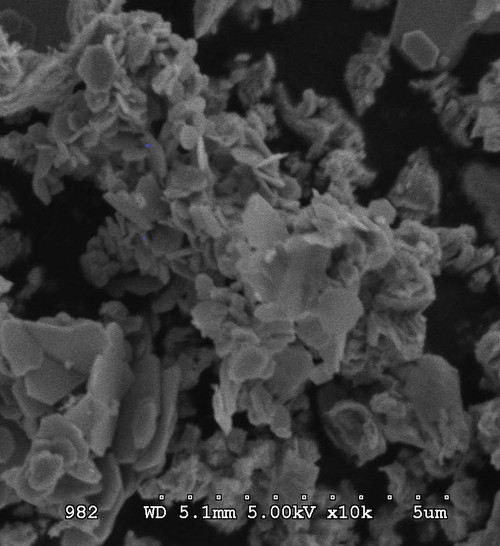
Product Description
The MKN-WS2-090 is a tungsten disulfide (WS2) nanopowder with a purity of 99.0%, an average particle size of 90 nm, a specific surface area of 30 m²/g as reported and hexagonal-lamellar morphology. It is supplied for industrial, laboratory and formulation evaluation where nanoscale WS2 is needed as a solid lubricant or lubricant additive.
Available pack sizes: 50 grams, 100 grams, 500 grams and 1 kilogram. | Tungsten Disulfide Powder Safety Data Sheet (SDS)
Safety note: Do not generate or inhale airborne WS2 dust. Keep away from eyes and skin and review the SDS before handling.
Technical Specifications
| Product Number | MKN-WS2-090 |
| Material | Tungsten Disulfide Nanopowder |
| Purity | 99.0% |
| Average Particle Size | 90 nm APS |
| Specific Surface Area | 30 m²/g |
| Morphology | Hexagonal-Lamellar |
| True Density | 7.50 g/cm³ |
| Chemical Formula | WS₂ |
| CAS Number | 12138-09-9 |
| Molecular Weight | 247.97 g/mol |
| Physical Form | Powder |
| Available Packs | 50 g, 100 g, 500 g, 1 kg |
| Product Use | Industrial and laboratory research; lubricant additive |
Technical note: APS is the average particle size and is not to be confused with the complete particle-size distribution. MKN-WS2-090 has an SSA of 30 m²/g and a hexagonal-lamellar morphology.
Key WS2 Nanopowder Properties and Applications
Key Material Characteristics
- 90 nm average particle size for applications requiring nanoscale WS2.
- 99.0% stated purity.
- Specific surface area of 30 m²/g.
- Hexagonal-lamellar morphology.
- True density of 7.50 g/cm³.
- WS2 is a low-friction solid lubricant material.
- Suitable for evaluation in high-load, high-temperature and vacuum-related lubrication systems.
Common Application Areas
MKN-WS2-090 may be evaluated for:
- Nanoscale solid-lubricant formulations.
- Oil and lubricant additive systems.
- Dry-film and surface-lubrication research.
- Precision sliding and contact surfaces.
- High-load lubrication systems.
- High-temperature and vacuum-related lubrication.
- Compatible coating formulations.
- Resin, polymer and plastic formulations.
- Industrial and laboratory materials research.
The final suitability is a function of the particle dispersion, concentration, carrier medium, substrate, surface preparation, load, temperature and working environment. Before using the application in production, it should be tested.
General WS2 Reference Values
| Coefficient of Friction | 0.03 dynamic; 0.07 static |
| Load-Bearing Ability | 300,000 psi for coated film |
| Temperature Range in Normal Atmosphere | Up to approximately 650°C |
| Temperature Range in Vacuum | Up to approximately 1,316°C |
| Chemical Formula | WS₂ |
| CAS Number | 12138-09-9 |
Important: These values are used as general reference values for the tungsten disulfide product family from the WS2 brochure. These are not performance test results for MKN-WS2-090 for particular batches.
300,000 psi is for a coated film, not loose nanomaterial powder. Actual performance will depend on substrate, surface preparation, dispersion, application method and operating conditions.
The 0.5 micron coating-film thickness listed in the brochure is not to be considered a specification for this product as it is for a coating application and could be confused with the 90 nm particle-size specification.
Safety, Handling and Storage
Store tungsten disulfide nanopowder in the original container, tightly closed, in a dry and well-ventilated place. Do not get in the skin and eyes and do not generate dust or aerosols. Provide adequate ventilation where airborne powder may be created.
When handling the powder, wear appropriate personal protective equipment including appropriate gloves and safety glasses with side shields. Choose respiratory protection suitable for exposure conditions and applicable workplace requirements.
The SDS classifies tungsten disulfide as:
- Skin irritation – Category 2
- Serious eye irritation – Category 2A
- Specific target organ toxicity, single exposure – Category 3 (respiratory system)
The SDS uses the signal word WARNING and states:
- Causes skin irritation.
- Causes serious eye irritation.
- May cause respiratory irritation.
- Avoid breathing dust, fumes, gas, mist, vapours or spray.
- The material is stable under recommended storage conditions. Avoid contact with strong acids and strong oxidizing agents.
Transport
The current SDS lists tungsten disulfide powder as “Not dangerous goods” under DOT, IMDG and IATA. This transport classification should not be interpreted as meaning that the powder requires no handling precautions.
Tungsten Disulfide Powder Safety Data Sheet (SDS) →
Frequently Asked Questions
- What does 90 nm APS mean for tungsten disulfide nanopowder?
- APS means average particle size. MKN-WS2-090 is specified with an average particle size of 90 nm. This value should not be interpreted as the complete particle-size distribution.
- What is the purity of MKN-WS2-090 WS2 nanopowder?
- MKN-WS2-090 is listed with a 99.0% purity in the current product specification.
- What is the specific surface area of this WS2 nanopowder?
- The current product specification lists a specific surface area (SSA) of 30 m²/g for MKN-WS2-090.
- What is the morphology of MKN-WS2-090?
- The current specification describes the powder as having a hexagonal-lamellar morphology.
- What applications can 90 nm tungsten disulfide nanopowder be evaluated for?
- The material may be evaluated for nanoscale solid-lubricant formulations, lubricant additives, dry-film lubrication research, precision sliding surfaces, coatings and compatible resin or polymer systems. Final suitability should be verified under the intended operating conditions.
- How should tungsten disulfide nanopowder be stored and handled?
- Keep the container tightly closed in a dry, well-ventilated location. Avoid dust formation and contact with the skin or eyes; provide appropriate ventilation and use suitable personal protective equipment as described in the SDS.
- Is WS2 nanopowder dangerous for transport?
- The current SDS lists tungsten disulfide as not dangerous goods under DOT, IMDG and IATA. This is a transport classification and does not eliminate the need to follow the SDS handling precautions.
Technical information notice: Product information is for preliminary evaluation only and does not guarantee performance or suitability. Review the current SDS, TDS, and product specifications, try a small sample first, and confirm suitability before bulk use. Read the full disclaimer